Spent an enjoyable and relaxing half term hol just south of Calais,
France at Le Touquet. I managed to fit in a bit of birding during the
week and even managed a lifer - Middle Spotted Woodpecker! My birding
was restricted to three sites: Le Touquet dunes and estuary, Baie de
Canche and Crecy Forest.
Le
Touquet is about 35 minutes south of Calais on the A16. It sits on the
south side of the Canche estuary and has a fantastic dune system which
have been well-protected and is a Natura 2000 site. The scrub and
woodland inland of the dunes held Nightingale and Firecrest and looked
great for migrants. The estuary itself was good for Spoonbills, Little
and Cattle Egrets, waders and gulls, plus a few Sandwich Terns. Black
Redstarts were frequently heard and seen around the town, often singing
from television aerials. There were a few Swifts and Serins around but
not many of either, which seemed a bit strange.
Reserve Naturelle de la Baie De Canche
This
varied reserve is about 15 minutes from Le Touquet, accessed just north
of Etaples (across the bridge from Le Touquet) and either side of the
D940. Parking is up a side road to the west of the D940 signed for a
campsite. There is a car park after about 20 metres on the right. From
this car park, you can walk the blue trail, which takes you uphill
through woodland and sandy heath. Our only walk was in the middle of the
afternoon so it was pretty quiet, apart from a few Nightingales. The
site is good for Nightjar, Woodlark, Honey Buzzard and Fen Orchid,
although I suspect you would need to go off the trail to find the
latter.

About
1km back towards Etaples is the red trail which is on the coastal side
of the D940. This is a short trail through wet woodland and scrub and on
to the coastal marshes. I was able to park on the wide road verge next
to the start of the red trail which saved a long walk from the reserve
car park. I had seen some local birders doing that the previous day so
realised it was ok. Out on the marhes, there are many ponds with
shooting butts which are heavily used during autumn and winter for duck
shooting.
The
fringe of the marshes had patches of sand dunes and reedbed and there
were a couple of big lagoons with nice hides overlooking them.
Bluethroats (white-spotted) were easy to find here and were singing
early morning. One male was watched feeding a brood of stripy
fledglings, hopping about on a dry muddy pool. They often skulked in the
reedbeds, but occasionally would sit up on top of the Sea Buckthorn and
phragmites.
Bluethroat, Nightingale, Zitting Cisticola etc singing after dawn.
I
was surprised to find three Zitting Cisticolas singing on the marsh
here, plus lots of Reed and Cetti's Warblers and one Sedge Warbler.
Water Rails were squealing from the reedbed and the main lagoon held six
Spoonbills, four White Storks and plenty of Little Egrets. Two Cattle
Egrets were hanging about with the cattle that were grazing the marsh.
Nightingales, Whitethroats, Lesser Whitethroats and Blackcaps were
common in the scrub, and I saw a Cuckoo and a pair of Stonechats.
Cattle Egret, Lesser Whitethroat, 2 x Nightingales, Reed Warbler, White Stork.
....
Crecy Forest
This
large managed forest lies about 30 minutes south of Le Touquet and is
easily accessed from Forest Montiers a couple of minutes off the A16.
The nearest car park to Le Touquet is the one just west of the A16 at
Forest Montiers on the east side of the forest (see map below - FM is on
the left hand side) from where you can explore the forest. The site is
managed for forestry but has some good deciduous woodland, scrubby areas
and good trails. It is worth using your smartphone and googlemaps to
navigate as it is big enough to get lost. We got a few ticks from our
two walks, so it is worth checking yourself after a visit.
On
our first visit, we arrived late morning so activity was much less than
my second visit, where I arrived at 6.30am, an hour or so after first
light. However, even in the middle of the day, Melodious Warblers were
still singing from the Broom and Birch scrub (see pic below) and raptors
were in evidence, with Common and Honey Buzzards and Hobby over the
forest.

On
my second visit the sun was barely up and the birdsong was magical,
with several species of warblers singing, along with Nightingales and
Blackbirds. The highlights of my three hour walk were a couple of Red
Foxes and several Roe Deer, Short-toed Treecreepers, Nuthatches, Crested
Tits, Firecrests, lots of Melodious Warblers and best of all, a Middle
Spotted Woodpecker. This was a species I was particularly keen to find
having failed to find them elsewhere in the past, and for the first hour
I saw and heard nothing but Great Spotteds. A bird which looked a
little smaller flew over my head and landed on a dead branch in the
crown of a nearby tree. To my delight, it was a MSW and perched long
enough for me to get a record shot. It was against the light so was
quite dark, but lightening the picture helps see the key features. It
flew out of the tree and didn't appear to go far but I didn't manage to
relocate it. I continued my walk adding Green Woodpecker. There are
apparently Black Woodpeckers here and I got a glimpse of a bird that
could have been this species on my first visit, but I couldn't track it
down. Other birds of note included Hawfinch, Jay, Marsh Tit and
Firecrest. Wood and Icterine Warblers also occur in the forest, but I
didn't find either. There was a photo of an Icky from the forest posted
on ebird the week before, mislabelled as a Melodious Warbler.


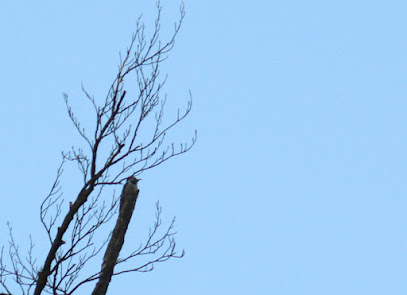

Firecrest, Fox and Middle Spotted Woodpecker.