Sunday, 22 October 2023

Flamborough Bunting

Together with Vicky and Luna, I headed over to Flamborough for a clifftop walk this morning, and to check out the bunting found at North Marsh by Simon Gillings yesterday. The latest gen was that it was probably a Red-headed Bunting, a super-rare species that is not yet on the British list. It has occurred before, but records currently reside on Category D, which relates to presumed escapes. This is understandable as many records related to adult males at odd times of the year, and during a period when the cagebird trade in Europe was very active. The fact that this bird had turned up on the same hedge as a Siberian Stonechat and a Little Bunting surely give it reasonable credentials? If not a Red-headed, it will be a Black-headed, which is still pretty rare but not in the same league as a Red-headed.

I didn't feel very optimistic about seeing the bird, and the thought of chaotic twitching scenes filled me with dread, but nevertheless, we headed along the clifftop in the bright morning sunshine to give it a go. Four Whooper Swans whooped past south over the golf course, pursued by a late Swallow. Several Rock Pipits were flitting about the cliffs too. News from departing birders wasn't great; the bunting had been flushed and had been lost, as it flew off across a large stubble field. 

Shortly after arriving at North Marsh, I saw two birders running across the stubble field. They were far too old and had far too much clobber to be doing this for fun; the bunting must have been refound. A few tense minutes later, and I had joined perhaps 30 birders in the corner of the field. The Bird Observatory had got permission from the farmer and were managing access - great stuff. After about 15 minutes of seeing Yellowhammers, Reed Buntings and Chaffinches hopping up into a hedge out of a grassy field, I began to wonder is it genuinely had been seen. Just as I had that thought, a pale bird hopped up on to the brambles, and there it was! Views were great of this rather large and non-descript bunting, lit perfectly by the autumn sunshine. It shortly caught the attention of a local Yellowhammer which chased it out of sight. A few minutes later and it reappeared again right on the top of the hedge, allowing me to get a bit of shaky footage. 


My experience of this species in first calendar year plumage is precisely zilch, so I won't be adding much to the identification discussion! The bird did look large-billed to me, with quite a streaked crown joining the streaking on the greyish mantle. The rump had a greenish-yellow tone and there was a pale yellow wash on the vent. The bird was weirdly tatty missing all bar one of its greater coverts and quite a lot of inner primaries too. Not sure what is going on with it! Anyway, it was good to see and hopefully those with more experience will confirm the identification.  

I had a quick look for the Siberian Stonechat but it had unfortunately disappeared for a bit. Whilst waiting a stunning female Hen Harrier flew past at very close range flushing a single Stonechat, but the Sibe didn't appear. It was time to go and hook up with Vicky, so I left the scene, very surprised and more than a little bit stoked to have seen the bunting, whatever it turns out to be.

Friday, 20 October 2023

Storm-blown

Storm Babet is pounding the east coast, and there is strong easterly winds and rain in York, so I thought it would be worthwhile checking a couple of local patches of water to see if anything had blown in. Two first-winter Arctic Terns on Dringhouses Pond got my pulse racing, but despite the good start I failed to find anything else. Jack had a Kittiwake down at Hemingbrough, and there are apparently a lot of seabirds in the Humber, so it will be worth checking round again early tomorrow.

Viewing at Dringhouses Pond is very difficult, with these pics taken through the bars of the entrance gate. The terns were spending most of the time at the south end of the pond out of the wind, only occasionally venturing up to the viewable end. 

There are only two previous autumn records of Arctic Tern in the York area, with the previous latest record being 17th October, which this surpasses.


A Long Slog

The weather boded reasonably well on Wednesday, with the start of a spell of easterly winds. If anything, it was perhaps a little too nice, with sunny spells and no rain to drop the migrants. I put in a lot of legwork round Flamborough Head, with little to show for my efforts. There were a few flocks of Redwings, Fieldfares and Bramblings arriving, plus a few Goldcrests and Chiffchaffs in the bushes, but the strong wind made birding tricky. 

By early afternoon, I had walked 20km, fallen in a nettle-filled ditch at Whelkie Wynds for little more than a Yellowhammer, got crapped on by a Herring Gull and managed to dip the Hartendale Gutter Radde's Warbler. Twice. A 90 minute seawatch was also a bit of a let down with two Arctic Skuas, two Arctic Terns, 14 Little Gulls and several Red-throated Divers all that was on offer. A few migrants came 'in off' including a Fieldfare that landed right in front of us on the clifftop.


 I decided to have another go round Old Fall and was pleased to see a first-winter Caspian Gull loafing in the field by the road. Before reaching the plantation, a message arrived from Simon Gillings, who had found a White-billed Diver off South Landing! Panic!

I sprinted back up the Old Fall hedge, past some bemused dogwalkers, and jumped in the car. At South Landing I ran down the road to the beach, where I spotted a little huddle of birders near the tideline. Scrambling over the chalk rocks at the top of the beach, I was soon across the sand to the huddle. To my dismay, they weren't watching the diver. The sea was massive and the angle was too low. I looked up at the viewpoint at the top of the steps; this must be a better place. Off I went, back up the beach across the car park and up the steps. 

With sweat pouring and optics swinging dangerously around I approached a couple of birders with a scope. They were unaware of the WBD, but my complete coincidence, had got it in their scope and asked me what it was! I was elated and clapped these complete strangers on the back. They clearly were delighted too, and within moments I had this majestic beast in my scope. It was an adult and an absolute stunner, just moulting out of summer plumage, with some white on the chin and lower cheeks, but otherwise immaculate. It was close in, just behind the breakers and slowly paddling east, occasionally ducking through a particularly large wave. I put an update out and within a few minutes other birders joined my on the clifftop. We followed the bird east towards Booted Gulley, drinking in this fabulous moment. Well done Simon! After a while, I decided to have one last go at the Radde's - unsuccessfully - and then headed home. 

White-billed Diver. Only my second in Yorkshire, after my first back in 1991. I did catch the tail-end of one at Flamborough a couple of years ago, but not really tickable. 


Tuesday, 17 October 2023

York Yank

Chris Gomersall found this cracking juvenile American Golden Plover near Raker Lakes, Wheldrake this afternoon (17th October). Only the second record for York, I popped out for a late lunchbreak to check it out. The bird was feeding with c400 Euro Goldies in the stubble and was often the nearest bird. It's long-winged, slighter frame along with its silvery colouration and striking head pattern made it stand out from its chunkier cousins. The long legs were apparent, which made the bird almost as tall as the Goldies. It was quite aggressive towards the Goldies, which meant we got good views of the pale grey underwing from time to time as the bird flapped about. The bird was in pristine plumage with upperparts notched in white, except for gold on the inner tertials and scapulars. The head pattern was bold, very white-faced, with a neat dark cap, with white forehead, lores and chin, and exhibiting an odd dark cross-shape, made up of the dark cap, large eye and ear coverts and bill. After a while, the flock was flushed and circled off to the east. Absolutely cracking!


 And some video:


Friday, 6 October 2023

Birthday Odonate

I always take the day off work to go birding, if this falls on a week day. This year was no exception and despite the unfavourable conditions for east coast birding, I thought I'd head that way to see what I could find. The lure of the Bempton Red-eyed Vireo was strong, so I started there, and failed miserably! Nevertheless, it was an enjoyable morning, seeking migrants in the lee of the brisk westerly wind and keeping a keen eye and ear out for the vireo. Several Chiffchaffs, a few Redpolls and Siskins were the main results, along with a handful of Goldcrests. Best of all, once the sun came out, three or four Willow Emerald damselflies appeared, around the small pond by the overflow car park. This, a recent colonist of Yorkshire, is the only damselfly still on the wing currently, joining hordes of Common Darters basking in the sunshine and the occasional Migrant Hawker darting along the sheltered hedgerows.

I headed over to the Outer Head at Flamborough after lunch, to walk the Old Fall Loop. It was quiet, with a dozen southbound Swallows moving through, plus small numbers of Chiffchaffs and Goldcrests in the bushes and a single Wheatear in the ploughed field at Cattlemere.

So, a quiet day bird-wise, but nice to get a new Odonate at least.


Sunday, 1 October 2023

Patch dedication


 I was just back from checking on the local Golden Plover flock, to see if an American Goldie had dropped in (without success) when a message came through to say that Jack Ashton-Booth had found a Grey Phalarope on his patch at Hemingbrough Gravel Pits. There hasn't been a twitchable Grey Phal in the York area before, so I went straight back out. Duncan picked me up at Fulford and we headed the short distance down to Hemingbrough. We met up with Jack and a few other local birders to watch the Grey Phal, looking a little forlorn on the water. After a bit, it perked up and started swimming about and picking invertebrates off the water surface. Always a great bird to see, it was a treat to see one at close quarters and close to home. As is normal with this species, this juvenile had started its moult into first winter plumage, with lots of pale grey feathers coming through on the mantle and scapulars. 

Top work by Jack and a good reward for dedicated patch watching. 


Friday, 29 September 2023

You lose some, you win some

West coast birders have been seemingly knee-deep in American warblers and vireos over the past week or so. It has been incredibly exciting watching events unfold online, and seeing the first jaw-dropping photos of these trans-Atlantic super-jewels appear. It has been really cool and I am not in the least bit envious, no. I am; massively!

Of course, what is good weather for cross-pond vagrancy is pretty dire for the east coast and looking ahead to early October, it is looking bleak, without a hint of east for the next fortnight. Despite the doom and gloom, it has been an exciting week with the first Yorkshire Sharp-tailed Sandpiper in a few years found by Alan Davies at Blacktoft Sands on the Humber. Alan was visiting from Wales - as if he didn't have enough birds to enjoy back home!! Fair play Alan, a great and well-deserved find.

I headed up there before work earlier this week, but sadly the bird had been flushed minutes before I arrived and despite checking the other pools and Singleton lagoon over and over, it did not reappear, so I left for work, feeling a little glum.

I have seen one British Sharpy before - see here - but I would love to see one in the home county. To be fair, it was a cracking hour spent grilling the waders, with five or so Curlew Sandpipers, 12 Spotted Redshanks and 3 Greenshanks the highlights. A Water Rail skulked along a reedy edge and a Marsh Harrier quartered the reedbeds. Nice. I spent a lot of my formative birding years with my Dad and his mate John, watching waders here, but these days I come here infrequently- not sure why as it is a cracking place. 

...

Later that day, another cracking bird was discovered in God's own. Nick Addey, up at Long Nab, Burniston, had found an Eastern Olivaceous Warbler. Now, this is a proper bird! Not your gaudy, technicolour Yank sprite, but a real identification-prowess-testing skulker. How it had landed up on the east coast in a southwesterly, I do not know, but perhaps there had been something going on, as there had been a few other south-east European bits on the coast nationally, dropped in by rain during the last few days perhaps. Either way, this was a quality bird for the UK, let alone Yorkshire and the pics of the bird coming from Long Nab were amazing. I was not around for the Flamborough Eastern Olly (the only previous county record, back in 2010) and the only one I'd twitched was a bird at Benacre, Suffolk in 1995 while I was at Uni, which I dipped, so this was a must-see bird.


Pipe Gulley, near Long Nab.

So, another early start and a dawn raid on the east coast. Shortly before I arrived, the welcome news came through that the bird was still present. Great! I picked up a young birder who had parked at the village - Austin from Wigan - and drove down the lane to the car park. After a short squelchy walk down the clifftop path, we spotted about a dozen birders actively looking into the gulley below. Within minutes, I could hear the 'tecking' call of my target, and seconds later, a pale warbler flicked on to the edge of the Blackthorn. Result! Characteristically flicking its tail down like an out-sized Chiffchaff and clambering around in the bushes, snapping hoverflies from the bindweed flowers, it showed brilliantly well. It had the feel of an Icterine Warbler in Marsh Warbler clothing, with lovely pale fringing on the tertials, coverts and on it's long primary tips. Strangely, I was expecting the bird to have dark lores, but this bird had very clearly pale lores, giving it quite an open-face. I checked this out in the Handbook later and actually the face pattern matched most of the pics, reminding me always to check more than one source of info! There was a hint of a dark upper border to the lores, a bit Booted Warbler-esque. The bill was narrow though, as expected and the paleish outer tail feathers were obvious, especially when the bird was against the dark foliage. 

Eastern Olivaceous Warbler, Burniston. Phonescoped.


The warbler seemed to be following a circuit round the bushes and could be tracked through its 'teck' call, which it gave frequently. It would occasionally sit motionless out in the open on a briar or twig, seemingly looking for an insect, before a quick burst of activity, as it moved through the bushes, or lunged after a prey item. It wasn't easy to phonescope, but I managed to get a view dodgy clips in the early morning light:


On views like this, the bird really was quite distinctive, helped by the call and tail-dipping. I could have quite easily watched this smart and educational bird all morning, but like with yesterday, time was ticking by and I had to get on, so I left, giving Austin a lift back to his car on the way out.

A Chiffchaff and Blackcap were present in the bushes too.

...

A further twist in this tale, was that the Sharp-tailed Sandpiper appeared again early morning at Blacktoft. So, you never know, I may get another shot at that too, before the week is out.


Sunday, 17 September 2023

Shearing

Eight hours seawatching at Flamborough Head was enjoyable yesterday, both for the good company and good selection of birds passing. The best of the seabirds were to the north of us, but good to see three Balearic Shearwaters, plus 25 Sooties, and 29 Arctic Skuas. Seven Pale-bellied Brent Geese went south and then returned north, whilst a good number of Teal, Wigeon and a few Pintail moved by. Forty Red-throated Divers headed past, some of them calling to each other, a rather eerie, deranged sound. A couple of Med Gulls were among the commoner gulls, plus one possible Caspian, but it could be a hybrid. Also, Whimbrel, Arctic Tern, 40 Common Terns, 36 Sandwich Terns, two Peregrines etc. Still no Fea's Petrel for me; perhaps the winds just weren't right this far down. On the land, Whinchat and Redstart on the Old Fall Loop were notable, plus a flyover Yellow Wagtail. 

Balearic Shearwater with four Manx. The bird starts off second from the front of the group then moves to pole position. Trying to work this out from the four dots on my phone screen is the reason behind my question at the start!


A glorious Sooty Shearwater oozing class. Lots of flapping in moderate winds.

Sunday, 10 September 2023

Wandering Booby

Following on from the Common Dolphins and Flying Fish a week or so ago, news of a Brown Booby off Flamborough on Sunday 3rd September, was incredible, but not entirely surprising. Scilly is hosting both Brown Booby and Red-footed Booby and there had been a report of another Brown Booby off Norfolk recently, so it was only a matter of time before one turned up off Yorkshire. 

I should have been at Flamborough that morning leading the YOC trip, but in a frustrating twist, I had caught Covid the weekend before and whilst mostly recovered I had little energy and didn't feel up to it. Jane and Rob Chapman had kindly agreed to take my place and were nearby on the clifftop when the Booby had been found. I was in York! I felt ok, so shot over there and spent two hours staring forlornly at the sea. An Arctic Skua flew past and 40 Little Gulls fed along the Flamborough front, but that did little to raise my spirits. It had gone.

The following day, I was back at work and news came through that the Brown Booby was now sitting on a rock on Filey Brigg with the local Cormorants! It then settled on the sea near Hunmanby Gap and gave many relieved  Yorkshire birders the chance to catch up with it. Sadly, I couldn't get over due to work and family commitments. The next day, the bird was still around the Yorkshire coast, having started off at Filey Bay and then flying north to Sandsend and Whitby. 

It was still present after work, so I decided I would have another try for this tropical seabird. An enjoyable, if slightly nervy drive over the Moors later and I rolled into Sandsend, to find out the bird had departed an hour ago (not sure why nobody reported that!) and had turned up again at Filey. I had a quick look offshore; the sea was like a mirror and over 20 Bottlenose Dolphins were feeding. I could have stayed and watched them, but my priority lay back south, so down the coast road I went, to Filey. With some great advice from Mark Pearson, I shot down to Hunmanby Gap, to see if the Booby would roost.

The shadows were lengthening as I walked down the track to the back of a cafe where I had a good view of the sea. I scanned the bay hard; there were lots of gulls, several Gannets and a couple of Red-throated Divers, but no booby. a distant juvenile Gannet piqued my interest for a few seconds, but it was only that; a juvenile Gannet. Thinking back to what Mark had said, I looked straight out from the gap and to my astonishment, there was the Booby! It was distant, maybe 3/4 to a mile out, and the light was poor. It looked much smaller than the nearby Gannets, similar in size to a Herring Gull, but with a long, cocked tail. The plumage appeared all dark at this distance, apart from a narrow white flash on its flanks, by the waterline. It had a pale bill, but the light wasn't good enough to discern colour. I needed it to fly really, and a few moments later it flew a short distance along the surface, revealing a dark throat and breast, sharply demarcated from the white belly. The underwings had a clear-cut white band up the centre. The upperparts including the long tail were entirely dark without the characteristic white band on the rump of a young Gannet. It really was the Booby! I tried a bit of phonescoped video, but the light and distance didn't help very much. I needed to get the news out in case there was any other birders nearby, so I went up the slope a bit til I got signal and put the news on Birdguides. I then returned to watch the bird until the gathering gloom made viewing impossible. Success at last!


Brown Booby: note the compact shape, long cocked tail and triangular head. 

Juvenile Gannet: longer-bodied, comparatively shorter-tailed and typical Gannet headshape.

 ...

I made my way back to York and was surprised to see that Birdguides who had put out my news had then sent a second message to say my report was in error. This was a bit wierd so I rang them to find out why this was. It transpired that there had been some birders in the car park, higher up the hill who had not see the Booby. They had seen some Gannets, so assumed the news was erroneous. Whether these birders had seen the Booby and dismissed it as a Gannet, or whether they hadn't looked far enough out, I don't know. A couple of days later, I spoke with Andy Gibson who had been in the car park that evening. He said he was pretty sure he had seen the bird and was fairly confident it was the Booby, but other birders present were unconvinced, or maybe were looking at other birds. 

Chapter Two.

The conjecture over my sighting had rather taken the shine off the experience, and also, my views had been pretty poor anyway. The Booby had continued to be reported, but had moved north to Teesmouth, being seen both from the north and south sides of the river. Early doors Saturday, the bird - which had been identified as an adult female - was still roosting on a shipping buoy off South Gare, so I decided to go and have another look. To my delight, the bird was still hanging out off South Gare when I arrived. 


 She spent much of her time loafing on various buoys, but occasionally flew around over the river, often pursued by the local gulls. Later on, she joined a feeding frenzy of gulls and Cormorants, where I watched her shallow dive and surface dive for small fish. She was very successful and I could see she was feeding well. Her small size was again apparent, as was her long tail. Looking at her sitting on the water at distance made me feel my identification of the Hunmanby bird was correct. 


Having enjoyed some great views, I switched my attention to the beach, where c100 Sanderlings were hanging out with a few Barwits and Turnstones. 

News from the north side of the river lured me round and I was soon enjoying a gorgeous juvnile Buff-breasted Sandpiper feeding with a small flock of Dunlins and a single Curlew Sandpiper on West Saltholme Pool. A cute juvenile Little Stint was feeding on the causeway here too, my first of the autumn and several Black-tailed Godwits and c20 Ringed Plovers were also noted.


Just up the road at Greatham Creek, I had brief but good views of the juvenile Pectoral Sandpiper feeding on the edge of the saltmarsh, with a few Dunlins. A winter-plumaged Spotted Redshank was roosting with lots of Redshank on the edge of the creek, along with 200 Dunlins, another Curlew Sandpiper and a single Knot. An overflying Peregrine briefly caused alarm in the small waders and the Pec vanished at this point; I think it flew to the north side of the creek with a Dunlin. An adult Spoonbill was also in the creek along with about 40 Grey Seals. It was time to head back to York after a very enjoyable morning's birding on Teeside.


September Gos

I've led a couple of YCN Goshawk tours recently. It is such a contrast birding the forest at this time of year. Birdsong has disappeared, with only the calls of overflying Siskins and Crossbills breaking the tranquil silence. It is harder to find Goshawks at this time of year. The adults seem to be quite secretive, and the best chance if provided by freshly-fledged juveniles cavorting around, sparring with each other and the local Buzzards. On Friday, we got brief but reasonable views of an adult which cruised across the valley and into the forest, before a juvenile male appeared overhead, circling around lazily in the hot afternoon sun, before drifting north. A Spotted Flycatcher watched us nonchalantly from a bare branch and 300 House Martins were gleaning insects from the trees, in a frenzy. Earlier, an early skein of Pink-footed Geese had flown high south, calling 'wink-wink' and hinting at the winter to come. A wisp of seven Snipe flew up the valley too, a slightly unexpected sight.

Juvenile male Goshawk and Spotted Flycatcher. Pics by Rob Bendelow.


Warming Seas


 I led two YCN pelagics off Staithes in two days, 25-26 August. Great views of Minke Whales on both trips, plus Sooty and Manx Shearwaters, Arctic and Great Skuas. Highlights were a bow-riding quartet of Short-beaked Common Dolphins at the end of the first day, and then an Atlantic Flying Fish on the second. Both species should not really be in the North Sea and could be a result of the warm plume of Atlantic water that has spread right across the Atlantic this summer. Common Dolphins are rare off Yorkshire, but there was a record of a mother and calf off Bempton earlier in the summer, but I can't find any records of Atlantic Flying Fish, so that is really interesting. 


Atlantic Flying Fish. Photo by Karoly Kantas

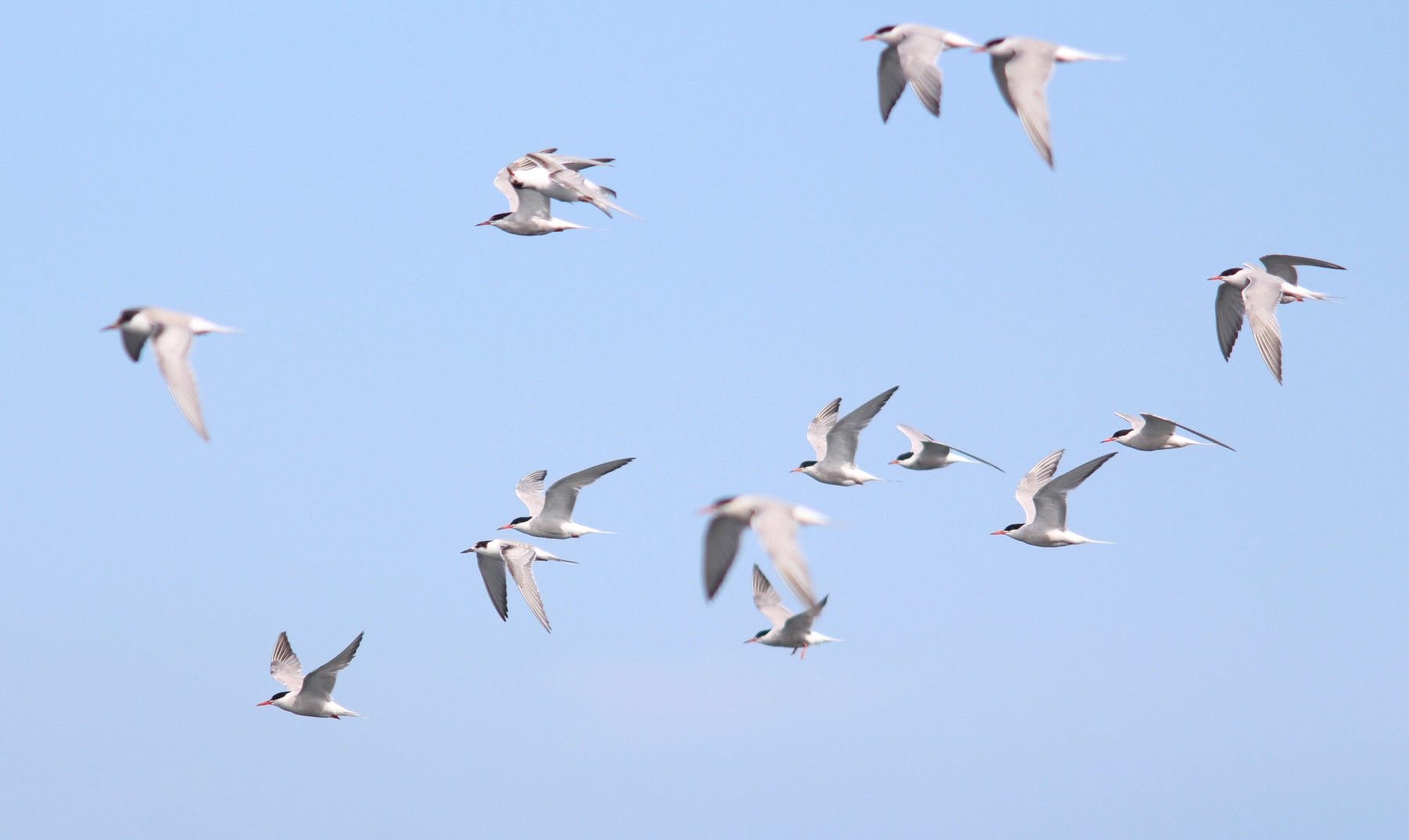
In Runswick Bay, I was surprised to see about 80 Common Terns sitting on the sea. I have seen this behaviour in Arctic Terns before on migration but not Common Terns. There was one juvenile Arctic among them. Good to see numbers of juvenile Commons, suggesting some colonies have escaped bird flu.


Minke Whales:


Double Teal

With a few hours spare, I headed east to Tophill Low to look for a juvenile Blue-winged Teal that had shown up the night before. This is a duck I long to find in the Lower Derwent Valley, so I wanted to refamiliarise myself with the species ahead of the influx of wildfowl into the valley in coming months. To my delight, shortly before I arrived a message came through to say birders twitching the first BWT had identified a second bird, an eclipse drake! 

I met up with Lee Johnson and together we enjoyed great views of both birds, paddling about in the lagoon and loafing on the islands. The juvenile was quite a distinctive bird, with a long slightly Shoveler-esque black bill, neat white loral spot and eye-ring contrasting with a neat black eye-stripe. The lack of a white tail stripe was a good feature too. the sky-blue wing coverts were seen once or twice when the bird was preening. 


The eclipse drake had a slightly more subdued face pattern, rufous underparts and more worn upperpart feathers. Nevertheless, with a good view, the female-esque head pattern was noticeable. It turns out this was a Yorkshire tick for me, so a bonus.


Also present, a dapper juvenile Ruff, adult Little Gull, several Green Sandpipers, Water Rail and a Marsh Harrier. 

Little Gull, Lapwing, Blue-winged Teal (right hand duck), Teal


Sunday, 6 August 2023

Three Day Weekend

Friday 4th August

With a northerly blowing, I headed out early to Flamborough for an all-day seawatch. Despite no rares, it didn't disappoint, with good numbers of Manx Shearwaters (200+), 18 Sooty Shearwaters and a big movement of terns, with at least 200 Arctic Terns, 600+ Sandwich and 150+ Common Terns. This was impressive and I scoured the flocks hard for a Roseate or something even rarer, without success, but the spectacle was incredible. Passage picked up in the evening with Manx Shearwater numbers increasing. Two juvenile Caspian Gulls were also floating around and my first Red-throated Diver of the autumn headed south.

 Manx (top) and Sooty Shearwaters.

Saturday 5th August

With heavy rain forecast, I headed down the valley to see if any waders had dropped in. Five Dunlins, 38 Lapwings, a Sniper and 12 Teal were on the flooded turf field at Sutton-on-Derwent, and nearby four Green Sandpipers and a Greenshank were on the flooded Low Grounds.

Mid-afternoon I received a message to say a Cattle Egret had been found by Andrew Schofield at Bolton Percy Ings. After finishing some jobs, I headed the short distance there and after a few minutes of squinting through gaps in hedges and trees, I managed to locate the diminutive heron with several of its slightly larger Little Egret cousins. This is only the second Cattle Egret I've seen in the York area; they are still surprisingly scarce. 


On the way back over Acaster Airfield I stopped to check out a flock of gulls loafing in the stubble. Several Lesser Black-backs were present including some dusky fresh youngsters. A bird sitting down in the stubble looked promising for an adult Yellow-legged, with a blue-grey mantle and no obvious mirrors in the primaries. Zooming up, it had a red eyering which clinched things, although I was pleased when it eventually stood up to show off its yellow legs and feet!


Sunday 6th August

The wind had swung back northerly, so I went east again. Unfortunately, it was quiet, with a lot less movin than on Friday. In six hours, I saw one Sooty Shearwater, 12 Manx, 8 Arctic Skuas, 3 Bonxies, 12 Arctic Terns, 2 Greenshanks, a surprise female Goldeneye, three adult Little Gulls and a single Caspian Gull. Nevertheless, it is always a treat to seawatch! My next seawatch is likely to be off Tenerife, so I will see what that brings!

The definite highlight of the long weekend was seeing flocks of terns passing by, including several gorgeous silvery snakes of Arctic Terns (top). It was a relief to see many juveniles among the flocks too, suggesting they have had a good breeding season in spite of the continuing impact of bird flu. Many of the Arctic Terns stopped to feed among the Kittiwakes and early evening one feeding frenzy held 59 Arctic Terns!