Sunday, 1 April 2018

COTF18 Day Two: Hot dogs

News of a roosting Pallas's (Great Black-headed) Gull at KM20 got the Terriers out of their kennels early, and we were soon heading up the R90 full of anticipation. The Jordanian mountains looked dramatic in the clear, dawn light, but sadly the gull had departed, leaving a gang of Caspian and Baltic Gulls. Two Black Storks flapped over lazily and a Hoopoe was noted. Cutting our losses, we decided to continue north to Yotvata.

Much the same set of birds was present as was apparent the previous evening, although Woodchat Shrike and Black-eared Wheatear were both new. Plenty of Northern Wheatears were in the fields along with several Isabelline Wheatears, including this confiding individual:


Issy Wheatear

Five Water Pipits were hanging out in the irrigated onion fields, with c100 'yellow' wagtails, and several Red-throated Pipits. A Desert Lark flew over calling as did a Corn Bunting. 20 Lesser Kestrels hunted insects from a line of wires - incredibly beautiful little falcons. Many northbound Swallows, Sand and House Martins cruised past; we wished them well on their long, perilous journeys. A Whitethroat skulked on the edge of a field, with a single Eastern Orphean Warbler sticking to some nearby trees with a couple of Lesser Whitethroats. Another Hoopoe showed, before news came through of a Turkestan Shrike on the Uvda Plains. Steppe Buzzards and Black Kites were beginning to move north as the air warmed, so we headed west.

Neot Samadar Sewage

On our way to Uvda, we called in at Mark's favourite site, some secret sewage pools at Neot Samadar. Despite the signs, we weren't tempted to drink the water! Several common waders were around the edges of the pools, and a smart male Redstart of the eastern race Samamisicus flicked past. A Bluethroat and a Cetti's Warbler were in a small marshy area, and a gang of 30 Trumpeter Finches lined the perimeter wires along with several confiding Spanish Sparrows. Two Euro Bee-eaters bombed north, calling joyously.


We checked the fields alongside the kibbutz, which were quiet apart from another Samamisicus Redstart, this time a slightly drabber first summer male.

First-summer male Eastern Redstart

Uvda Shrike twitch

It was pretty warm, no, pretty mentally baking by the time we reached the gravelly expanses of the Uvda Plains. Not the best time for us Terriers to be out in the sun, but we had a shrike to twitch. Some sandgrouse flushed as we exited the car - nice, Spotted Sandgrouse. They melted away. Some others piqued our interest, but despite a walk on the plains, we couldn't find them. Nearby, our first White-crowned Black Wheatear showed well. On to the shrike site, a military compound, we strolled across the empty expanses, frying rapidly. Wading through prickly scrub and piles of rusting razor wire suddenly made me realise that shorts were not the ideal twitching garment. Action trousers would be better, or failing that, skinny jeans.

Some birders pointed the way, and we soon got on to the smart male Turkestan Shrike, hanging out in shrike-tastic razor wire. Views were tricky, but with a bit of patience, we managed some good views. We were melting, so I cadged a lift off the other birders who had driven down to the compound rather than walked the half a mile across the desert. They ran me back to the car, but decided it was too rough to get our car back to rescue my fellow terriers. I waited in the car with one of the birders, Yael, while her husband went back to collect Mark and Rich. Great stuff - we owe you Mr and Mrs Shiff!


Turkestan Shrike.

Saved by Air Conditioning, we headed for the Shizzafon Kibbutz for some lunch. Out back was a lovely shady area which felt like a little migrant trap. Sure enough, a few common warblers were mooching about in the trees, and then Terrier Captain announced 'Flycatcher' and we all spun round to see a stonking male Semi-collared Flycatcher perched on the fence! Get in! Our soup arrived - delicious - and we enjoyed this whilst the flycatcher flicked about.


Next up, we felt we should put in an appearance at the Eilat Birdwatching Centre, the IBRCE. Lying just north of the city, the area is a small marsh and scrub area, adjacent to a large lagoon, capping some large saltpans.


This is one of the first areas of cover birds spot as they make landfall at Eilat and hence it is a magnet for birds. Mid-afternoon was not the best time for birding, and the strong north wind didn't help either. Nevertheless, we got stonking views of this Bluethroat:

Bluethroat, with no tail.

We said hello to a few of the local guys, before heading south to finish yet another awesome day at North Beach. First on the menu were the freaky White-eyed Gulls hanging out in no-man's land on the Jordanian border buoys. They were pretty weird looking!


Other birds around included Sandwich, Common and three carrot-faced Caspian Terns and a large flock of c200 Garganey! Boom! Closer inspection revealed a single Teal, a couple of Shoveler and five Wigeon within the flock. Cool. The sun went down, and we headed home, shattered but stoked.


COTF18 Day One: The Terriers hit the playing field

Today, the 20th March was our first day birding the Champions 'Playing Field' the area of southern Israel, around which teams will race on the 26th for the chance to become Champions of the Flyway. For the next few days, we planned to familiarise ourselves with the sites and species to give ourselves a good chance on race day.

Holland Park, Eilat

Up and at 'em, the three Terriers to have made it to Eilat so far (me, Rich and Mark; Darren would be joining us tomorrow) were out early to hunt some migrants. Under Mark's expert direction, we headed for Holland Park, on the northern edge of town, notching up a couple of smart Tristram's Starlings along the way. These black, Mistle Thrush-sized birds sported bright orange wing-flashes and only seemed to be around first thing in the morning.

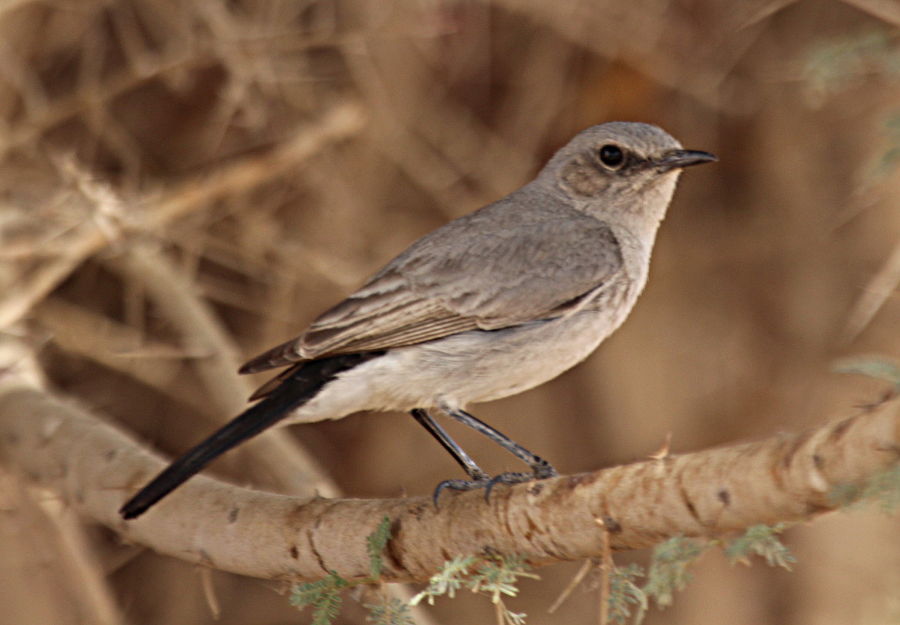
Holland Park is not a park in the conventional sense, more a large dry wadi, with a scattering of arid-loving Tamarisks and other bushes.  It provides a haven for weary migrants dropping in over the city. Almost the first bird we saw was a rather cool Blackstart, a pair of which seemed to be nesting in the wall by the entrance. They flared their ample black tails and seemed a little bit unimpressed by our appearance. They'd seen it all before!

We worked our way up the wadi, full of effervescence to be out birding after our long journey, admiring trees along the way.


The first day birding in an unfamiliar land is always superb, with unfamiliar calls emanating from thick cover and unidentified birds skulking unseen. Really exciting stuff! The commonest migrants were Lesser Whitethroats - we saw c20. With a bit of effort, we managed to pull out a couple of Ruppell's Warblers, two lumbering, shy Eastern Orphean Warblers and about five Eastern Bonelli's Warblers. The latter, with silvery white underparts and lemon wing-edges and rump are known round here by the much more evocative name of Balkan Warbler. We liked that, so we stuck with it.

White-spectacled Bulbuls were common, as they proved to be throughout the area, singing their sweet, thrush-like notes, along with handsome Sand Partridges, Pale Crag (Rock) Martins, Tawny Pipit and Palestine Sunbirds. A male Pallid Harrier cruised over north followed by a group of 45 Baltic Gulls and a male Lesser Kestrel, while four local Arabian Green Bee-eaters put on a fine display. Mark pulled two Striolated Buntings out of the bag much to our delight, one of which posed for pics.

 Striolated Bunting
Sand Partridge

It was heating up, and we were starting to bake, so we opted for some shade up at the nearby cemetery. A female Blue Rock Thrush greeted us, along with a tail-less White Wagtail, parading on the lawns around the graves, but stars of the show were a pair of Arabian Green Bee-eaters which hung out in the trees.


Blue Rock Thrush, and Arabian Green Bee-eaters.

KM20 Saltpans

Back up the Route 90 to KM20 (each KM is handily marked by the side of the road), which I skillfully missed and had to drive another five KM before I could pull a naughty U turn across the central reservation, before returning through the police checkpoint and back to KM20. KM20 is a series of saltpans right on the Jordanian border and so is a no-go after dark unless you want to have a serious run-in with the Israeli military.

We drove east into the saltpans through a date plantation and passed some old poly tunnels. Atop one was a tiny, yet handsome male Namaqua Dove, with jet black face and breast. He happily sat in the sun surveying the scene.

 
A strong, hot northerly was blowing across the lagoons, shrouding the Jordanian mountains in dust. The birding was unbelievable and we Terriers did not know where to look first. On the near edge of the saltpan, a selection of Kentish Plovers, Ringed Plovers, Little Stints, Dunlin and wagtails picked for insects, with Marsh Sandpipers, Redshanks, Black-winged Stilts and Ruff in the water.  A Greater Sandplover was among the Spur-winged Plovers on the far edge, with a Little Ringed Plover too. On the bund, a large flock of c100 wagtails fed in a frenzy.


Wagtail frenzy

On closer inspection, they proved to be spanking Black-headed Wagtails, mixed with Blue-headeds, one or two Grey-headeds and some mind-blowing hybrids, including the distinctive Superciliaris, which has a black head and a massive yellow eyebrow. Several White Wagtails were hanging out too, getting in on the action.


Wag-fest

Marsh Sandpiper.

Out in the lagoon, hordes of Slender-billed Gulls picked insects from the water surface, around the legs of majestic Greater Flamingoes. Here, somewhere, was a major rarity - a Lesser Flamingo. Fortunately, compared to its commoner cousins, it was tiny, and easily picked out from the horde. It could have literally walked through their legs, without ducking! Here and there small groups of Shovelers and Pintails loafed, adding a touch of the familiar among the cosmic birdage.


Greater and Lesser Flamingoes feeding, while a Slender-billed Gull looks on.

Team Leica Red Kites led by Alan Davies turned up - a nice bunch of lads. Also, Yoav Perlman, one of Mark's mates arrived, and we all shook hands, swapped birding gen and smiles, before posing for photos, things that would become part of the routine over the coming days.

Round to the north end of the saltpans a flock of 100+ Garganey on the water blew my mind - I am more used to scanning flocks of Teal for one or two birds! The mint looking habitat to the north was well worth a look: a Pallid Harrier cruised past, and there, among the bushes, we spied three elegant Dorca's Gazelles.


This was magical birding. We decided to head north to Yotvata, as the allure of Bimaculated Larks was too much to withstand. Mark dug deep in his memory to remember the right track, but sure enough he found the way and soon were enjoying breathtaking views of a male Pallid Harrier that eyeballed us as it quartered the arid ground near the circular field. Nearby, large flocks of Short-toed Larks scuttled about on the sand, and tight gangs of Spanish Sparrows zipped by to roost. Scanning the onion fields yielded a selection of wheatears, mostly familiar Northern types, but here and there a pale, upright Isabelline. Both Red-throated Pipits and Tree Pipits called overhead and a stonking pied Caspian Stonechat fed from the weed tops. Shortly, some other birders put us on the Bimaculated Larks, three of which fed unconcerned on the seeds of a small bush. Until they were flushed by a hunting Pallid Harrier - unbelievable scenes!

Bimacs, flushed by a Pallid Harrier.

But more was to come! We bumped into a tour group, led by a couple of American birders. They were going to stay on and look for Egyptian Nightjar. We decided this would be a great idea and they seemed happy for us to hang out. As it got dark, a Stone Curlew called eerily from the onion fields to the north. A large flock of Black Kites wheeled like bats over the date plantation before settling into roost. Several Pallid Harriers came in to roost, many of which sat on the irrigation boom over the circular field. Amazing! Right on cue, A nightjar showed up. We were all surprised by the bird's small size and obvious wing and tail spots. This was no Egyptian! Sure enough one of the guides nailed it -"It's a Nubian Nightjar!" Wow! What a mega bit of luck. This was a massive surprise as this species shouldn't really be here. The bird fed around the edge of the circular field and then drifted away. Shortly, one then two pale forms appeared- Egyptian Nightjars! Awesome! They glided about and then settled in the dust allowing good scope views. Brilliant and a fab end to our first day on the playing field.

Yotvata scene

Champions of the Flyway 2018 #1 19th March: 14703 STAR

After months of fundraising and awareness-raising, the time had arrived for the Zeiss Yorkshire Terriers to depart a freezing, snowy Blighty and head south to the scorched, arid lands of Israel, for the Champions of the Flyway 2018. A wonderland of birds awaited as we boarded our Easyjet flight to Tel Aviv, and within five short hours, we descended over the Mediterranean into the Israeli capital. Yorkshire Terrier Captain, Mark, spotted our first bird before we had even landed - a Squacco Heron!

It was a pretty simple journey to Eilat, or so we thought, but we were soon lost on the ring roads around Tel Aviv in rush hour traffic - not a great start! Nevermind, we saw Jay - of the Black-capped atricapillus subspecies, along with Red-rumped Swallows, Black Kites and Ring-necked Parakeets. With some dogged determination, the Terriers soon found the right road and headed south.

After an hour of rolling barley covered hills, we pulled into a service station for some tea and birding. My first three 'lifers' of the trip - Palestine Sunbird, Ruppell's Warbler and Graceful Prinia  zipped about in the scrub around the car park, but first prize went to a lamb kebab, which was to be pretty much my last meat of the trip.

Calamity struck when I couldn't start the car. This automatic with added theft prevention measures needed a precise sequence to start it, none of which involved a key! After many attempts Rich called the breakdown line and had the first of many conversations with a very patient Israeli woman called Amy. Amy did her best to help us, but failing that, she arranged for a mechanic to come out. It was now dark, we were three hours north of our destination, and a bit strung out. Dig deep Terriers! I decided to have a wonder round the car park to see if I could spot anybody who could help. The first guy offered to help, but he simply rang Amy again, causing her unnecessary confusion. Next up, I approached two young lads who were trying to jumpstart a minibus. One of them spoke great English so he agreed to help. Much to our embarrassment and complete relief, he explained that the code number we had to enter to unlock the immobiliser, 14703, had to be followed by a *. Well, if only we had known... He tried this and it started first time! Hand shakes and smiles all round. We headed south and after three hours, the technicolour lights of Eilat welcomed us into the legendary birding town. We all crashed out, unable to sleep for the excitement about what tomorrow would bring.


Eilat by streetlight.