Tuesday, 3 January 2023

The Mighty Thor!

New Year's Eve, and up early to drop Vicky and Addie at the railway station; they were heading to the Royal Albert Hall to watch the Nutcracker. Whilst I would love to see a Nutcracker, the ballet is not one of my top interests, so I planned to head out to Castle Howard for another look at the Ring-necked Duck - if it was still there - and hopefully get better views than I had the day before in the failing light. 

Heading east down the A64 I received an incredible message: Walrus in Scarborough Harbour! What the ****?! 

My mind raced, and instead of turning left towards CHL, I gunned east towards Malton and the coast. 

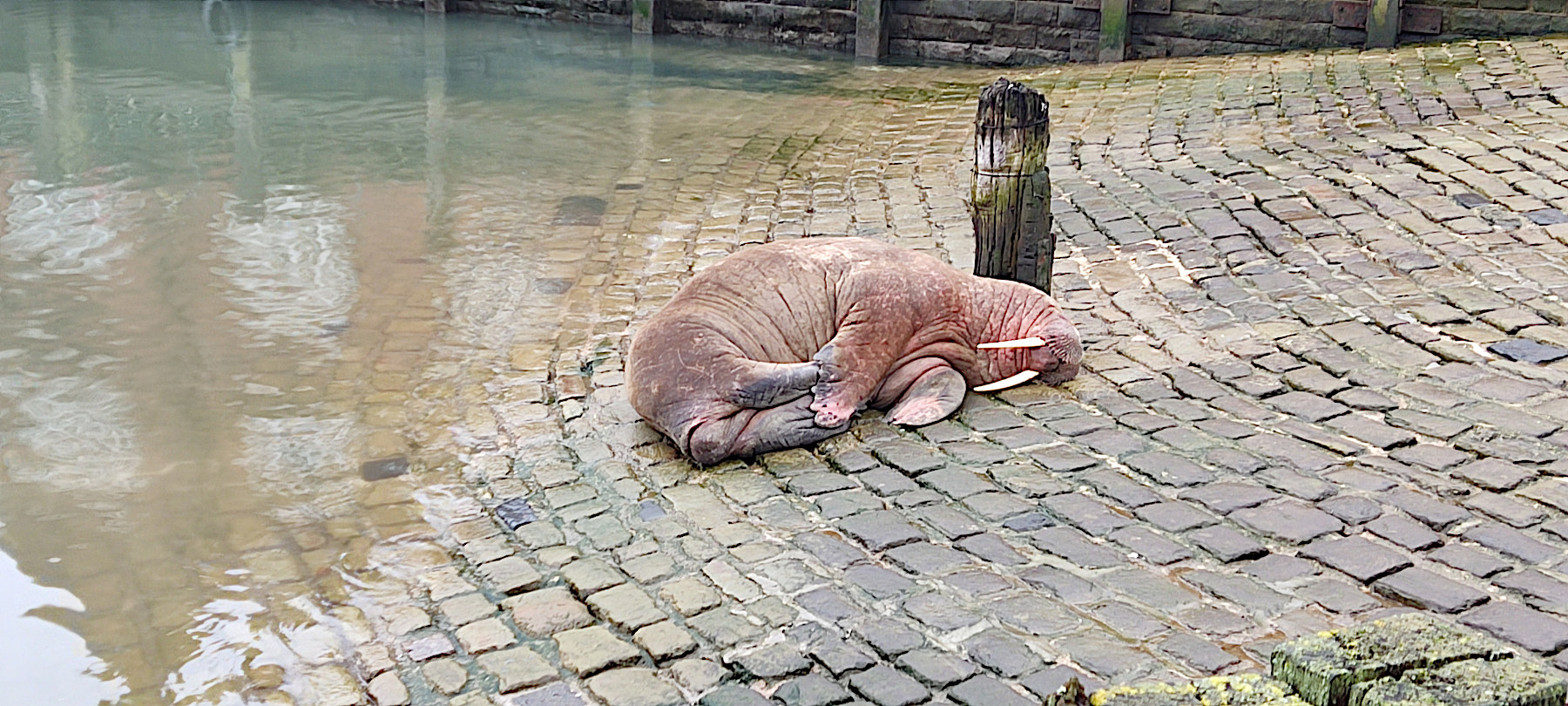
A short ride later, and I arrived on to Scarborough seafront just before 9am. I drove north past a crowd of about 50 people peering over the railings into the harbour - this was a good sign! Finding a spot on the roadside, I legged it back to the south end of the harbour and joined the throng. To my amazement, there, only five metres a way, dozing on the cobbled slipway was a vast behemoth, complete with sabre-tusks:  the Walrus! I was particularly impressed by his muzzle, covered in pencil-thick wiry bristles, which are apparently used for detecting food in the soft sediment of the seabed. His toenails were pretty cool too, a few inches in from the end of his leathery flippers. He was an impressive animal and every so often would lift his head to glance around with his tiny eyes, showing off his whopping tusks. He shuffled further up the slipway as the cold water of the rising tide lapped at his flippers. 

The giant pinniped was totally unbothered by the assembled throng of admirers, letting off steamy breaths into the cold morning air. The gasps of awe and amazed smiles from the people around me added to the sense of wonder I felt, witnessing the first Atlantic Walrus to be seen in Yorkshire. What a privilege. This was a three year old male, named Thor, who was originally seen in Petten, Holland on 6th November, before travelling to Brittany and then north to the south coast of England, where he hung out at Pagham Harbour and Calshot in the middle of December. He hadn't been seen since, until pitching up on this slipway, late last night. 


The local police and British Divers Marine Life Rescue had responded quickly and cordoned off the slipway. They were present in numbers making sure Thor was left in peace and that admirers were given information about him. Everybody present behaved impeccably and it was great to see the delight on the faces of everybody who saw him, especially the children. 


I was absolutely stoked to see Thor, having missed one of his cousins on the Scillies in summer 2021 by one day! I hope this is a one-off and not some climate-related problem that these incredible creatures are facing in their Arctic homes, forcing them to wander south.

At the time of writing, Thor has made a reappearance; in the yacht club at Blyth in Northumberland (2-3 January). Hopefully his welcome will be as warm there, as it was in Scarborough.

------------------------------------------------------------------------------------------------------------------------

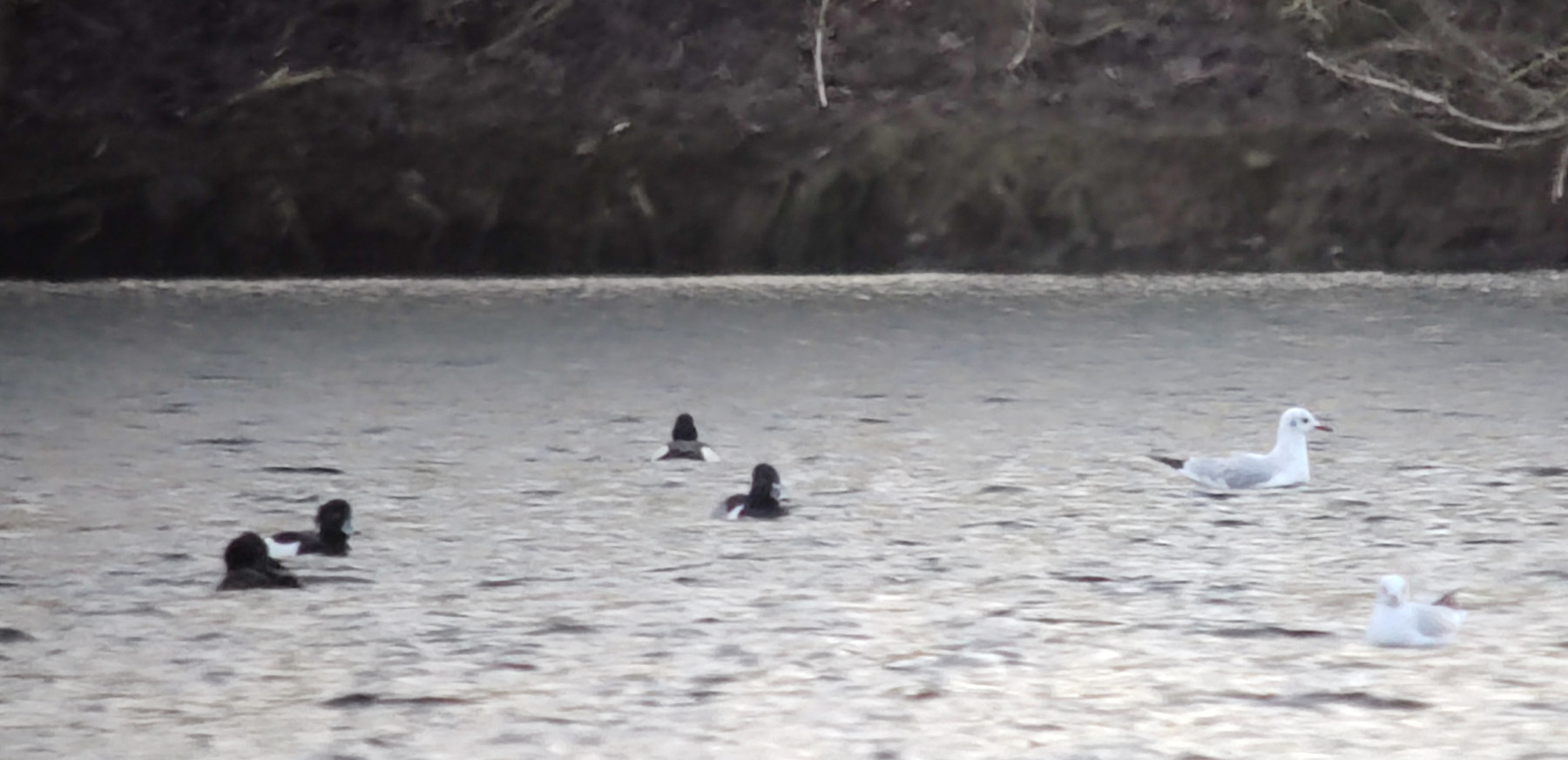
I headed off just before 10am and stopped off at Castle Howard Lake on the way past. The Ring-necked Duck was showing beautifully at the west end (near the road), busily diving with the Tufties. Lovely. 


----------------------------------------------------------------------------------

Some more of Thor....


Christmas Present

Vicky gave me a great birthday present this year: a day of birding in North Norfolk, with a night at Thornham Deli. What's more, we were ditching the kids and the dog at the in-laws, allowing whinge-free fun! 


 We managed to get away just after lunch from the in-laws in North Hertfordshire and took advantage of the dry weather to check out the saltmarsh at Warham Greens. First, a Marsh Harrier cruised past, closely followed by a ringtail Hen Harrier and a Merlin. A delight to see this trio, but I was hoping for something a little rarer! Right on cue, the orangy juvenile female Pallid Harrier winged her way across the saltmarsh just after 3.30pm. At one point, she tailed the Hen Harrier closely, allowing a great comparison through the scope. She headed back west, flushing the Merlin which had perched up on a pine tree- see video below. The Pallid Harrier remained distant, though her pale ruff, dark secondaries and plain orange underparts could be made out through the scope, along with her slighter frame and narrower wingtips.


We ate heartily in the Jolly Sailor Pub that evening and enjoyed a few pints. The strong winds abated suddenly during the night and were succeeded by rain and gloomy skies. Not to be defeated, we headed to Brancaster to look for a Hume's Warbler that had been wintering by the pool, just west of the beach road. The weather was poor, but after a while, I could hear the Hume's calling from the large Sallows on the far side of the pool. I hoped it would follow a circuit of the pool and after about 15 minutes it began calling much more closely at the east end of the pool. I headed down there and quickly picked up the bird as it moved through the bushes. A typically pallid, grey-green phyllosc,with dark bareparts and duller buff greater covert wingbar and supercilium. The bird approached quite close and I managed to get a record shot, despite my camera being soaked and the light being dreadful. The little spryte moved off through the bushes and vanished; I headed back to the car to dry off.

We headed over to Titchwell for a coffee and some hide birding, to keep out of the weather, though it was already too late for my soaked trousers! We had an enjoyable couple of hours here, although I couldn't locate the Long-billed Dowitcher from the previous day. In fact, there were few waders on the marsh, apart from a handful of Avocets, Dunlin and Grey Plovers. A Greenshank on the brackish marsh was a bonus and a few Red-breasted Mergansers were on the leaden sea.

Next up was Holkham, where a herd of about 100 Euro White-fronted Geese were grazing in the field by the coast road. We headed down to the beach and checked out the sea - more mergansers, Common Scoters and several Great Crested Grebes (it was too windy to spend too much time looking)- before heading west, where we located the eleven wintering Shore Larks in the roped-off area. They fed very close to the path, completely unbothered by our presence; absolutely stunning birds. A nice end to a most thoughtful Christmas present.

Friday, 30 December 2022

York Ring-necked Duck!!

Andrew Schofield found a cracking drake Ring-necked Duck at Castle Howard this afternoon. I dropped everything and dashed out to see it, before it got dark. I met Duncan down there and we enjoyed good views of this smart bird as the light faded. If accepted this will be the ninth record for York and the first away from the Lower Derwent Valley. There has been only one other sighting in the area since I returned to the York area in 2010, a drake at Bubwith Ings on 10th October 2019, which had sadly gone the next morning. 

Also present at CHL, a Great Egret, several Goosanders, lots of Mandarins and a modest gull roost.


Tricky conditions for phonescoping, with strong winds and failing light!

Monday, 12 December 2022

Paying Homage to the King

Finding myself not far from the beach the other day, it seemed rude not to pop a little farther up the coast to pay homage to the drake King Eider, that had turned up at Redcar. The bird was showing on a rolling sea, feeding on the Mussel beds just offshore, with a gang of Common Eiders. Attendant young Herring Gulls attempted to steal Mussels brought to the surface by the ducks. His highness was tricky to watch, disappearing underwater frequently and being hidden by the swell when on the surface, so I spent quite a bit of time getting arriving birders on to him. I walked back, pausing to enjoy a large flock of Sanderlings and Turnstones, and a solitary Red-throated Diver fishing in the surf.


Click here for a video montage of the king on YouTube


Friday, 9 December 2022

Out of a Clear Blue Sky

Working at home gold yesterday, when this smart Brambling dropped in out of the clear blue sky. 

It spent the morning feeding on Rowan berries and spilt seed under the feeders, and occasionally having a drink. A very handsome bird, it fed well so I was surprised not to see it again today. 

All pics through the slightly steamy window, so not great!


Sunday, 20 November 2022

Coot-foot

Felt a bit low this week, a combination of post-holiday blues, long nights and dreary weather. A few hours over at Flamborough Head lifted my mood considerably, with the highlight being a Grey Phalarope found whilst searching the south side of the head for Little Auks. The bird was actively feeding off Cattlemere, flying about a lot, before dropping on to the sea to feed. At one point it flew over a Little Auk and having shown the phalarope to another birder, I switched my attention to the Dovekie. This proved to be a bad move as I could not refind the phalarope, which a number of birders arrived to look for. Oops! 

And if you have ever wondered what the name 'phalarope' means, it means coot-footed, a nod to this group of waders' lobed feet, an adaptation for swimming. And thus similar to a Coot's! 


Another four or five Little Auks showed up, along with an Arctic Tern, a Brent Goose, c20 Eiders and a Puffin. A nearby birder asked if we could point out a Little Auk if another one showed, and immediately Craig Thomas pointed one out just below us in the surf - class!

This Dovekie seemed quite happy, diving through waves that were too big to ride and spent a fair bit of time preening and bathing.

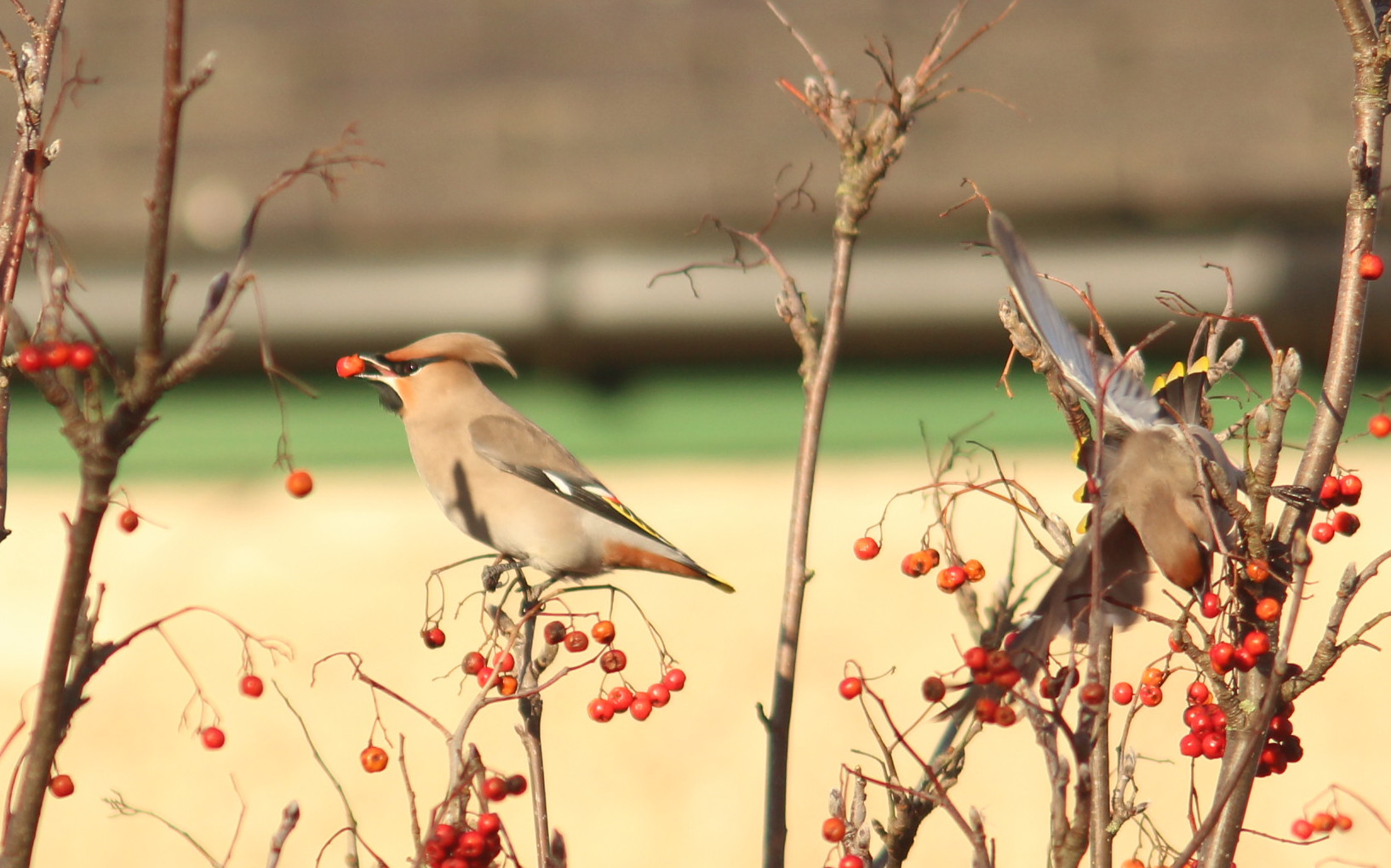
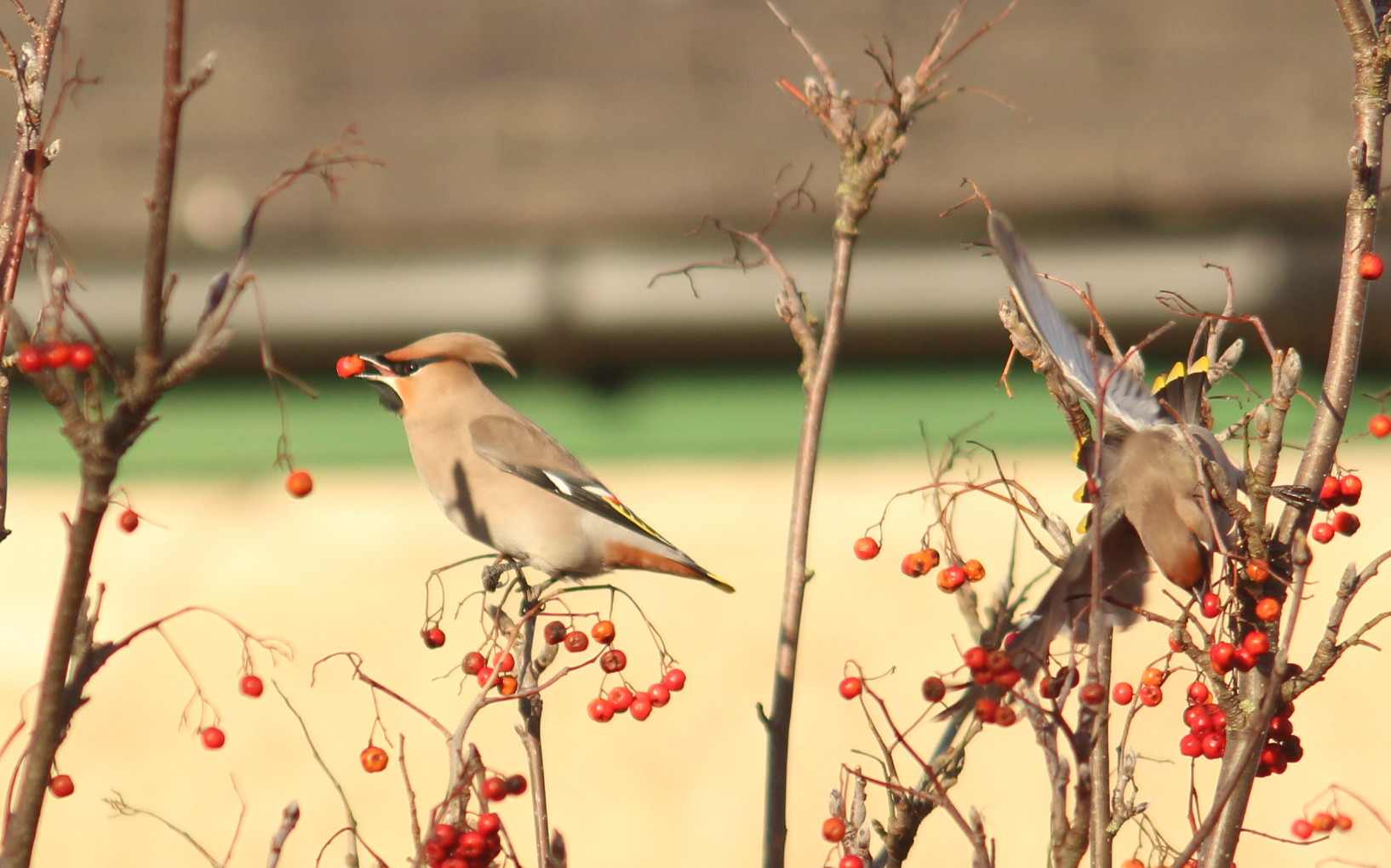
Earlier, I checked out the flock of six Waxwings feeding on Hawthorn berries in the village. I got a few pics from inside the car as they fed on berries. Later, the sun came out and I briefly joined the 40 or so photographers (and two or three birders - how times have changed!) who were enjoying immense views of the Waxwings which had doubled in number to 12. It is strange how Waxwing flocks increase like this. Presumably overflying birds are pulled in by the resting flock's calls. Four of the birds seemed to be adults, with nice red waxy tips to the secondaries and hooked yellow edges to the primaries. The rest were first-winters. Apparently two more turned up later. The birds were resting in a large tree between bouts of berry-gorging in a Rowan across the road. Occasionally, they would drop down to a puddle nearby, to drink. Once stuffed with three or four berries, they would return to their lofty perch to chill and digest.

 You can just make out the waxy tips to the secondaries in the bottom blurry photo.


Also, seen on my walk were two Woodcocks in Old Fall, Chiffchaff, c6 Goldcrests, Siskin and c35 Blackbirds feeding along Old Fall Hedge. Two Fieldfares and small groups of Starlings came 'in off' showing that migration is still going strong.


Tuesday, 15 November 2022

Yorkshire Bottlenose Dolphins

Just came across a little video of Bottlenose Dolphins filmed with my phone on one of my Yorkshire Coast Nature Seabird and Whale trips from July this year. So amazing to see these animals thriving so close to home. Enjoy!


Arctic Orcas

Spent a fab weekend in the frozen north of Norway, 300 miles inside the Arctic circle, with my best mate, Philip.

The main reason for the trip was to look for Orcas, which follow the Herring into the fjords, which are seeking shelter in the winter. Since seeing Orcas on my honeymoon in British Columbia, back in 2003, I have become a little obsessed with these majestic devilfish and was desperate to see these Type 1 Eastern North Atlantic ecotypes in the icy waters of the Norwegian Sea. This was going to be my chance!


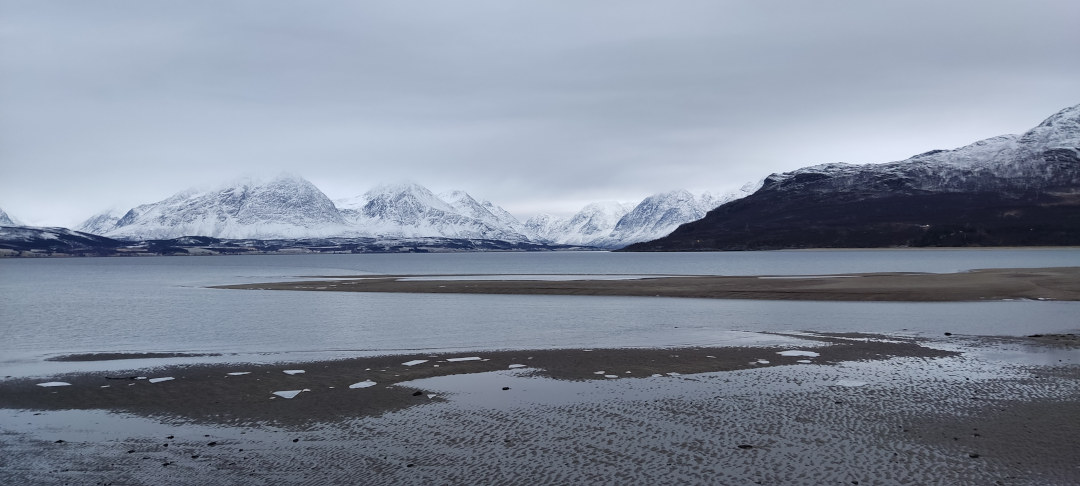
We spent our first day birding around the area, checking out the scenery and local wildlife, as far as the Finnish border. It was cold - really cold - with snow and ice covering the uplands and even down to sea level on the first day. Birding was challenging as most stuff had departed for the winter, and we failed to find any Siberian specialities in the few hours of daylight we had available. The woods were iced up and silent, apart from borealis Willow Tits, (Northern) Bullfinches and the occasional Jay or Magpie. An angry mob of Hooded Crows and Ravens directed us to an immature male Goshawk which eventually broke cover and flew straight over our heads -unfortunately our cameras were in the car, but it was a handsome, streaky beast and it powered off across the fjord towards the adjacent wooded hillside. Three barndoor-esque White-tailed Eagles were seen during the day, plus plenty of Velvet Scoters, Long-tailed Ducks, Red-breasted Mergansers and a solitary Great Northern Diver. We scoured Common Eider flocks for rarer cousins, without success. 

One of the highlights of the day was encountering a couple of large herds of free-roaming - but domestic - Reindeer up on the high plateau near the Finnish border.  Reindeer in most of Norway are domesticated like these, with the only wild animals in the far east and south, but they were still great to see doing their thing, licking salt off the road! 

The other highlight was seeing how the birch and willow forest cloaked the mountainsides, creeping up the slopes and becoming patchy montane scrub in the higher areas. It gave the mountains a really different character to the bare, overgrazed fells back home and a glimpse of how projects like Wild Ingleborough could look in a few decades. It would be great to come back and see what this looks like in summer. One day, maybe!


Breidvik and adult White-tailed Eagle


Forest track somewhere near Nordbotn and Willow Tits (both pics by Philip Precey).

The Norway-Finland border. There was not much, apart from a rock cairn and this sign.
 

Montane woodland and scrub at c600-900m

Orcas

I could barely get to sleep the night before this trip! The chance to see Orcas anywhere is great, but to see them in the spectacular surroundings of Arctic Norway was just too exciting. We met our guides for the day down at Tromso harbour, as the first hint of light was starting to show in the leaden sky. I chose the boat trip with Brim Explorer because their vessel is a hybrid catamaran, meaning they switch to electric power when in the area where the whales are, to reduce disturbance. They also have a marine biologist on board who ensures the clients learn a lot about cetaceans and also makes sure we do not disturb the animals at all. I was very impressed with the way they operated the trip, not least because you could get a pint on board! 

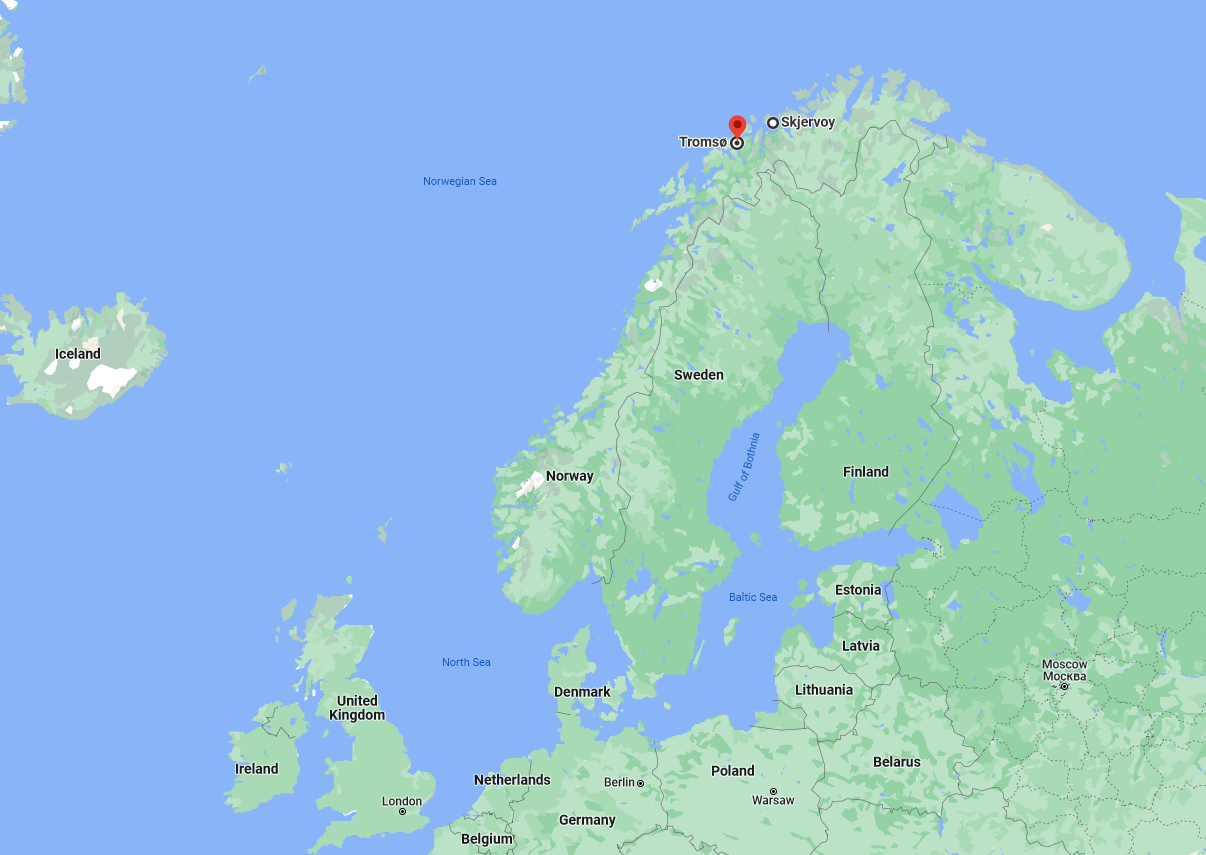
The impressive Brim Explorer and a map showing Tromso and Skjervoy. It is a long way north!
 

We headed northeast towards Skjervoy, but came across a pod of Orcas off Russelv, so didn't go quite so far. Due to the chilly, wet weather, most clients stayed inside for the whole time, so we had lots of space to share on the multiple decks, with the other dozen brave souls. I think some of those inside may have looked up from their smartphones and lattes to see the Orcas out of the window!

The Orca pod included a female identifiable by the parallel black scars on her grey saddle, as NKW-162 and hopefully the Norwegian Orca Survey will confirm some info about her and the rest of the pod. 

NKW-162 

Her saddle complete with scars:

The pod were hanging out in the fjord, feeding on Herring, and they approached very close to check us out a couple of times, giving breathtaking views. It was pretty emotional as always, seeing these incredible, beautiful animals so close, in such stunning surroundings. Fortunately, the rain and icy wind hid my tears! I had forgotten how conspicuous Orca blows are and also how it is quite noisy- being audible at quite a distance, even in breezy conditions.

The pod contained a large adult male with a collossal two metre tall dorsal fin, which came slowly out of the water like a triangular periscope. He was usually accompanied by a younger male with a smaller, though still impressive fin. There were three or so adult females too, including the one we identified, plus some immatures and a calf, maybe a couple of years old. 

Top two, the adult male, bottom the younger male
 

One of the other adult females.

The pod. Gorgeous!


There were good numbers of Little Auks feeding in the area too which were scattered by the surfacing Orcas. You can just about see them in the videos.

The Orcas hung out for about 90 minutes before they drifted away. The light was starting to fail, so we headed back to Tromso. 

Minke Whale hunting is still a thing in Norway, so it is good to come here to watch whales. We told as many people as we could why we had come, but it was heart-breaking to see whale meat products for sale in some of the tourist shops in the city. It was dreadful to think that people who go out on these whale-watching trips may then go and buy a whale meat sausage, without thinking about the consequences of their actions.

To watch a compilation of Orca videos I filmed on the trip, click here.


 It seemed apt to celebrate our Orcas with a pint from Brim's bar as we sailed home!

...

Our last day was spent walking round the north end of Tromso island, looking for birds. We added a few species to our small list, including Northern Treecreeper, Goldcrest, Blue Tit and Black Guillemot (sadly not Mandt's!). Soon, darkness descended again and our trip came to an end.

Tromso, on a dreary afternoon. 

Above- drake Common Eider. Most of the Eiders we saw close were not borealis, to our surprise. Below, a bunch of Long-tailed Ducks in Tromso harbour.


Thursday, 27 October 2022

Old Friends

Two Whooper Swans were on the pool at Wheldrake Ings this afternoon, my first of the autumn. Plenty of Fieldfares and Redwings passing over, plus 37 Pinkfeet and two Cetti's Warblers skulking in the reeds.