Tuesday, 26 March 2024

Icelandic Travellers

With the nights drawing out, it was my first chance for a quick post-work dash to Wheldrake this evening. 32 Whooper Swans were resting on the ings at Wheldrake, just outside Tower Hide - a fine sight. About 6.30pm they got pretty excited, necks erect and calling constantly; a fantastic sound. A family party headed off, but realising the rest hadn't joined them, they circled back round and joined the flock; well, almost. One of the youngsters didn't notice and headed off south towards the refuge and out of sight. Strange! Ten minutes later, it still hadn't returned and the herd decided it was time to go and they headed off into the dusk to the north. 

The impressive flock of Black-tailed Godwits had been feeding in the shallows; I had counted over 500 when they were flushed - there was clearly a lot more - probably well over 800, as was counted the other day- a new record for the LDV. I checked the wings as best as I could, looking for the black underwings of a Hudsonian - maybe a little optimistic - or the plain upperwings of a Bar-tailed - maybe more likely. I found neither, but the spectacle was amazing to watch. 

A horde of Icelandic Black-tailed Godwits, swirling over their Whooper Swan neighbours. 

I headed down to Swantail with Duncan, and shortly after arrival the lost young Whooper Swan flew back towards the main flood, clearly a little distressed at losing its family. I felt for the young bird, as its family were now long-gone to the north. I hoped that another herd would come through and it could join up with them and a little later, to our relief, that happened and 52 birds came north low over the ings collecting the lost youngster. I have always wondered how sociable birds get split up from the flock and then become vagrants - perhaps this event demonstrates how this can happen so easily. 

This young Whooper was lucky. I guess some birds get split up and then latch on to the next nearest species, leading them to end up travelling with them, perhaps out of the usual range. 

Migrating Whooper Swans; one of the finest spring wildlife spectacles

Having checked through the hordes of ducks for a Garganey - to no avail - we headed home, enjoying five Sand Martins hawking over the reedbed and at least three Water Rails causing a commotion in the ditches next to the boardwalk.

....

I arrived home to the good news that the insurance company are going to pay out for my smashed binoculars - what a relief! Now the big decision about what to get....


End of an Era/Car-roof Binocular Disaster!

A couple of visits to the LDV over the weekend yielded my first Sand Martin of the year, a single bird flying over the ings at Wheldrake. An impressive herd of 190 Iceland-bound Whooper Swans were at Wheldrake Ings yesterday, having a rest before continuing northwest. The flock of Icelandic Black-tailed Godwits has grown to a collosal and record-breaking 865; the site has clearly become a very important stop-over for them. 

My biggest news, however, was the disaster that befell my trusty Zeiss FL binoculars. These were the first 'top of the range' bins I had managed to afford, once I started earning, back in 2004, and they have been used pretty much daily ever since. They've had a few bumps and bruises along the way, and have the eyepieces replaced at least twice thanks to the Zeiss maintenance crew at Birdfair, but have been round my neck or glued to my eyes for many of my most memorable wildlife encounters over the last two decades.

So, on Sunday, when the unexpectedly warm spring sunshine at Thorganby caused me to put my bins on top of the car while I took my coat off, I wasn't expecting to end an era of Ziess-powered birding. 

I arrived at Wheldrake a few minutes later, and after donning my scope, I headed over the bridge and paused to scan the Low Grounds. Wait! No bins. I dashed back to the car assuming I'd left them on the passenger seat - apparently not. I then remembered what I had done. I assumed they would have dropped off in the car park back at Thorganby, and I began to panic thinking that somebody may have found them and I would never see them again. I sped back there and leapt out of my car. They were nowhere to be seen. A voice from the orchard 'are you looking for your binoculars?' My heart leapt - 'have you found them?' I enquired desperately, to which the dismaying answer came: 'no, we saw you driving through the village with them on the roof of your car five minutes ago'. My heart sank.

Back I went to Wheldrake, scouring the sides of the road. After a surprising distance - given how the road twists and turns through Thorganby - I spotted a crumpled shiny black heap in the gutter. It was my bins, and they were totally smashed. I was absolutely gutted, this really was the end of an era; my most prized possession obliterated by a momentary lapse of concentration. I was so upset, that despite having my scope with me, which would have been fine for some birding at Wheldrake, I went home. 


 My beloved FLs...RIP. 

....

Post-script

Having shared this image of disaster on Twitter/X, I got a lot of lovely comments and shared stories of similar bins-related mishaps. This made me feel a bit better; at least I am not the only accident-prone birder around. In the meantime, I have borrowed my wife's bins, which are not bad at all. I am now hoping I will get a call from Zeiss, offering me a free replacement pair, although I suspect that call will never come!


Wednesday, 20 March 2024

York Merg


Tim Jones found this handsome male Red-breasted Merganser at North Duffield Carrs yesterday, and it fortunately stayed long enough for me to shoot down at lunchtime to see it. After a short but anxious drive, I arrived to find Chris Gomersall watching it from Geoff Smith Hide - phew! The bird was asleep, with punk crest askew most of the time, indicating it had flown a fair way the previous night. A couple of times he awoke and gave a bit of display to rather non-plussed Teal and Tufted Ducks - although I was quite impressed. The bird stayed all afternoon and was seen to depart high to the north late afternoon. 

Mergs have been really rare in the York area in the last decade with no twitchable birds, so this one was very welcome and was a York tick for all those who saw it. Well done Tim!


Also present were two possibly three drake and one female Scaup, the Lesser Scaup-like Aythya hybrid and a new hybrid, possibly Ferruginous Duck x Pochard. A couple of Chiffchaffs were singing and the local Redshanks were displaying, giving a very spring-like feel to the site.

Sunday, 17 March 2024

Oh! For a better camera lens...

I have led three Goshawk Tours for Yorkshire Coast Nature in the last week, and the birds have been spectacular. After another wet week, yesterday dawned bright and clear - and a little bit chilly. I had high hopes, and sure enough, within ten minutes we picked up an adult male Goshawk, circling over the forest, his white underparts gleaming in the sunshine. He drifted down the valley, being replaced by his mate who was having some trouble with four second calendar-year birds. The sparring didn't seem too serious, almost playful, with some brief aerial skirmishes high above the valley. The male returned and so for a while we had six Goshawks together - pretty awesome! One young male stooped at a Woodpigeon, missing by a fraction, though it almost looked like he had the speed and accuracy to take it, but didn't bother. Very cool to see, nevertheless. We headed up the valley and the adult pair returned from the melee and showed very well, circling with a bit of relaxed display right in front of us, and at times, overhead. Of for a better camera lens! My wife's 200mm just wasn't powerful enough, otherwise I would have got some good pics. Views through the scope were fantastic! After lunch, we headed to a different part of the forest where we had a further three Gos, plus an unseen calling bird, deep in the forest. A sublime day ended with frustration, when my car wouldn't start. I sat in a cold car for 2 1/2 hours waiting for the AA to sort me out, which thankfully they did. I did see two roding Woodcock at dusk while I was waiting and a rather furtive Sparrowhawk on the hunt, which relieved my frustration.

Top two: Adult male Goshawk; third pic, immature male Gos; bottom, the adult pair together -male at the top.


Sunday, 3 March 2024

York's first Lesser Scaup? Not quite...

For the second time this winter, some of the local birders had expressed interest in a duck in the LDV that was showing characters of Lesser Scaup.This would be a first for the York area and after several years of increasing rarity in the UK, this winter had seen a reverse in fortunes, with a real influx, so if we were going to get one, surely this would be the year. With deep flooding since November, the valley has supported good numbers of diving ducks, including several Greater Scaup, so if any Lesser Scaup was passing, there would be a good chance of it dropping in. 

The first bird to get local birder's pulses racing was a female type, but photos showed that to be a Tufted Duck with extensive white feathering around the bill base. Female Tufties can show this frequently, but this bird was at the extreme end, but the shape of the patch was not right for LS, nor was the colouration of the mantle and flanks. Whilst some claimed it had some Scaup parentage, I couldn't see that myself; it just looked like a Tuftie to me, with standard upperparts and flanks, head shape and size.

Fast-forward to the last week or so, the valley was deeply flooded yet again and distant views of a drake Scaup-type on Wheldrake Ings had generated a lot of interest. Towards the end of last week the water had dropped enough for birders to get to Tower Hide and some rather record shots showed a bird with some really pro-Lesser Scaup features: the head shape had the classic peak to the rear-crown, it looked fairly small and the back a little darker than a nearby drake Greater Scaup. This looked good! Comments from birders on site were very positive but unfortunately, the bird was feeding on Swantail Ings, rather distant from Tower Hide so hadn't been nailed. If only we could access Swantail Hide! 

The watery view from Tower Hide.
 

I was keen to get down there and have a look for myself, and managed to do so on a rather wet Friday afternoon. Unsurprisingly, nobody else was present and wading through the floodwater in pouring rain made me start to doubt my own sanity. However, the chance to clinch a first for York was plenty of motivation to battle down to Tower. I soon found the Scaups feeding actively with the other diving ducks. The light was bad, it was raining and the ducks were diving frequently. 

This wasn't going to be easy - or even possible! The 'Lesser' stood out from its larger cousin and I could see why it had caused some excitement. The headshape looked spot on, as it had in photos I'd seen, with a nice peak at the rear and a steep forehead. The bill was parallel-sided and blue, perhaps paling towards the tip. It was difficult to discern the extent of any black on the tip at first. The upperparts appeared mid-grey and uniform, clearly darker than the Greater Scaup nearby, but I couldn't tell if this colouration was due to thick vermiculations (lines), as you'd expect in Lesser Scaup, or just a mid-grey base colour, more typical of a hybrid. 

'Lesser' Scaup on right hand side, with the drake Greater Scaup in the middle and the third bird on the left (I will mention that in a minute).


After a while, the two decided to have a preen and clambered on to some floating vegetation. The 'Lesser' looked smaller than the Greater but I wasn't convinced it was really small enough. I'd noticed that when they were diving, it was sometimes difficult to tell which bird I was looking at - the size difference wasn't really what I would have expected. This rang an alarm bell with me and sowed the first seed of doubt in my mind. Secondly, that grey back looked very smooth and didn't really seem to have the same base colour as the back of the Greater...

Drake Greater Scaup (left) and 'Lesser', facing away. You can clearly see the difference in back colour, despite the terrible light.


After a heavy downpour, the sun came out briefly. The Scaups immediately started bathing and splashing around. I stared hard to see if the bird would do a wingflap and reveal its two tone wingbars (Lesser should have a grey wingbar across the black primaries, and a white bar across the secondaries. Greater Scaup and hybrids tend to have white wingbars throughout. Sure enough, the 'Lesser' did three wingflaps but managed to be facing towards me every time! Typical. 

With better light, I noticed to my dismay that there seemed to be black on the tip of the bill. A pure drake Lesser Scaup should have a tiny amount of black on the nail of the bill. This bird seemed to show black on the nail and bleeding on to the sides of the tip. This feature alone ruled out Lesser Scaup, indicating mixed parentage, and made squinting through my scope at the other features rather academic. So, close but no cigar and Lesser Scaup still evades the York list.

A little while later, I came across a third Scaup-type, which until that moment I hadn't noticed. The Lesser type seemed to stick closely to the Greater Scaup, whereas this bird seemed happy hanging out with the Tufties.  This third bird also looked a little like a Lesser Scaup though not as convincingly. I then got myself very confused and realised perhaps I had been watching the original hybrid and it had just moved along the flock. Wierd. Either way, this bird wasn't a Lesser Scaup either. 

I put out the rather disappointing news, although caveating it to say if the bird was seen much closer and the features were in fact spot-on, then I would be surprised, but pleased to be proved wrong. 

...

3rd March.

I found myself at Wheldrake again in rather better light this afternoon. Bumping into Duncan, we walked down the riverside path, which was disgustingly muddy and flooded, to the viewing screen. The three Scaup were still on Swantail Ings, but marginally closer. I was able to confirm my suspicions that the bird was in fact a hybrid and the third bird seemed also to be a hybrid although a little less Lesser Scaup like. It was still a little smaller than the Greater Scaup, had the same dark back but the headshape was between Lesser and Greater, with an insignificant rear peak. Perhaps these two hybrids were siblings? So it seems we have one Greater Scaup and two Aythya hybrids, presumably both Pochard x Tufted Duck. It is massively frustrating that this has been the result, but hopefully the genuine article will turn up this spring as birds begin to move north. A pair of Lesser Scaups turned up in Lancashire yesterday and it was interesting to see all the salient features on these, compared to the two birds we have analysed in the LDV this winter. The distances we have had to deal with have been really challenging, so hopefully when a real Lesser turns up, it will be on the pool so we can get a better look!
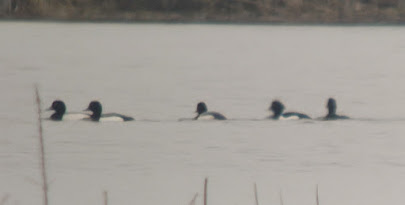
L to R: Greater Scaup, second hybrid, original hybrid (facing away) and two Tufted Ducks. The second hybrid is clearly smaller than the Greater, but bigger than the Tufties.


Among the Tufties, the original hybrid is at the front on the left, with the Greater two ducks to the right. The secodnd hybrid is to the rear facing left.

L to R: Greater Scaup and original hybrid. The second hybrid is behind the Greater and mostly obscured.   

Original hybrid with the Greater Scaup. Note how the hybrid is not that much smaller, it's back is quite a flat mid-grey, and doesn't really have the same base colour as the Greater; no coarse vermiculations can be seen, which should be visible from this range. In the upper photo, you get a suggestion of the black on the bill tip, though it is not easy to see in the pic. 

It is possible that the first hybrid is the bird seen previously at Slaynes Lane in South Yorkshire. This was also considered to be a Lesser Scaup until closer views confirmed it was a hybrid. So it is not just us York birders who get frustrated by these Aythyas! The very first Lesser Scaup I twitched in the UK was at Gouthwaite Reservoir in the late 1980s, not long after the first UK record. By the time my Dad and me had arrived, birders had identified that bird as a hybrid. So, this pitfall is always on my mind with this species. I have seen about a dozen in the UK over the years, but only one in Yorkshire, so it would be great to get one here in York. One day soon, hopefully!

...

I stayed on to do the gull roost and it was interesting to see how many of the Black-headed Gulls had acquired their hoods now. A partially leucistic snowy-white BHG came in to roost, the first I've seen this winter. A first-winter Lesser Black-backed Gull came in too, but very few large gulls at all.


Sunday, 25 February 2024

Challenging Yank

With a bit of time to spare, I headed down to Bubwith where good numbers of birds are present due to the floodwater being a bit shallower than elsewhere in the valley. There were stacks of ducks and waders on North Duffield south ings, but the light wasn't great and a strong cold wind was blowing straight in my face. I switched my attention to the river as the male American Wigeon had been showing here on and off all week. Unfortunately, despite over a hundred Euro Wigeons milling about in the sunshine, the Yank wasn't with them. I decided to trawl through the big flock on the flooded ings, which after several chilly minutes paid dividends, when the gleaming white crown of the American Wigeon caught my attention. It was facing away and asleep, but the creamy-white head was eye-catching. After a bit, it turned side-on, which made things a bit easier and after a challenging few minutes, I managed to get another two birders on to him. 

My first view. A bit of a challenge. Can you see it?

Easier with a yellow ring round it!

Other birds of note included 222 Pochard, between here, Bubwith and Aughton Ings, several Ruff, a couple of Redshank and a few Whooper Swans.


Unexpected Wax

Waiting to meet my sister at Heslington Sports Village car park, to go birding up in Wykeham, I noticed a bird atop a small tree that I thought surely must be a Waxwing. I reached for my bins (always keep them handy), assuming it would just be a Starling, Chaffinch, or similar, but to my delight it was a Waxwing. It flew down towards me into a bush on the edge of the car park and started eyeing up the rosehips, about the only fruit left around these parts. There were plenty of Waxwings around before Christmas, but they've mostly spread south and west so this is the first one I've seen in York this year, so a little unexpected.


Sunday, 18 February 2024

One good duck, deserves another...

I went up to the forest early doors and despite the gloomier-than-forecast weather, it did not disappoint. The forest was alive with birdsong; spring is really gathering momentum with the mild weather. Song Thrushes, Chaffinches and Crossbills were belting out their songs, and the local Goshawks were active, chasing off young from last year in some high speed pursuits across the valley. One youngster, a male, flew directly over my head, but against the bright cloud was largely silhoutted. The territory-holding pair were calling continually, and engaging in plenty of display, but apart from some early views, most action over the other side of the valley.


Top two: adult female displaying. Bottom two, one of the harrassed young males, just trying to find his way in this busy forest.

.....

On the way back, I received a message that the Chapman family (Rob, Jane and Tom) had found a drake American Wigeon at Bubwith Ings. Great! Neil Cooper had seen one at Melbourne in mid-January; it was then seen again a day or two later on Bubwith Ings, but hadn't been seen since. The valley has been deeply flooded making birding tricky, so I guess it could have been hanging out unnoticed for a month. Alternatively, it might have had a trip to the Humber with some of the Wigeon, looking for better feeding, and had now returned. Either way, it made for a fine sight, chilling on the grassy edge of the flood with plenty of commoner cousins, quite unaware of the mini-twitch it had created! The gathered locals informed me that Tim Jones had just seen an adult Kittiwake feeding with the small gulls over the wet fields behind the flood - strange! I scanned through the flock which had just flushed, and picked up the Kitt, which flew along over the field before disappearing behind the trees. A smart, unexpected bonus - nice one Tim! I enjoyed a few more minutes of the American Wigeon, my first in the York area for five years.


Friday, 16 February 2024

Long wait for a Long-tail

 Long-tailed Ducks are mega-rare in the York area, despite being a regular, but scarce passage migrant and winter visitor along the Yorkshire coast. It has been a good winter for inland records in England, with a few in the north, so I had had my fingers crossed one might show up and break my 'duck'. On Tuesday, I had a meeting over at Grassington with some of the senior team at YWT and it was with shock and a little dismay that as I arrived on site, I saw a bunch of excited messages from fellow York birders congratulating Stuart Rapson, who had just found a Long-tail at Castle Howard! I was stuck in the Dales for most of the day, so it seemed unlikely I was going to get there in time to see it. Fortunately, the meeting finished ahead of schedule and the trip back to York was smooth, so after catching up on a bit of work admin, I decided to head over before the dusk slammed shut. There had been no news since late morning, so it was with trepidation that I made my way down the path by the lake. I scanned the water hard, checking the flocks of diving ducks carefully. Alas, there was no sign. When Long-tailed Ducks turn up inland they either disappear within a few hours or stay for several weeks. It appeared that this bird, which seemed to have been the individual that had spent the last few weeks at Pugneys Country Park in West Yorkshire, was heading coast-wards and it looked like it had maybe moved on during the afternoon. I reached the end of the lake path and with no more water to check, I turned to head back, with a sinking feel of an impending dip beginning to envelope me. Would it be another 20 years before I got a shot at another York Long-tail? I hadn't even seen the Smew which had been found this morning. Gutted! I carried on scanning as I wandered back and to my delight, I suddenly had my bins on the Long-tail!

She immeditely dived, opening her wings as she went under. She spent a good 45 seconds underwater and on surfacing, was only up for about five seconds before disappearing again. No wonder I'd walked right past her! I decided to try and get closer, as I was looking into the light. It took me about ten minutes to refind her, during which time I began to think I was losing the plot! Fortunately, she surfaced again in my field of view and this time I managed to track her. A smart bird, and really dinky compared with the local Tufties and Goldeneye. The bird seemed ot have a pinkish wash near the bill tip, making me thing the bird might be a young male, but later discussion confirmed it is a first-winter female, and the pinkish colour is actually just pale grey. This Long-tailed Duck is my 228th species in the York recording area and my first new addition in 2024. What will be next?


...

Today I had the day off and headed back up to CHL to see if the Long-tail was still there. Again she took a bit of finding and this time she was right down the far end in the company of a few Goldeneye. She again was diving repeatedly and once took flight and did a bit of a fly-round, soon returning to the same spot. 

After watching her for half an hour, I decided to head off to look for other things. Two Barnacle Geese were loafing on the lake and a Cetti's Warbler was singing in the reedbed near the road. 


Feisty Finches

 It is early spring and the volume of birdsong has gone up a few notches. Song Thrushes started belting out their varied songs at the beginning of the month, along with Chaffinches, Skylarks and Dunnocks. In the last few days, mild weather seems to have got the local Blackbirds going, and they are delivering their beautiful, summery notes to the growing chorus, hinting at warmer days to come. 

In the garden, the first Frog appeared last night (15th Feb) but no spawn yet. Last year, we had spawn on the 19th, so we will see if that record is broken. Pink-footed Geese have been on the move north, with several skeins heading over the village and elsewhere. It has been a good winter for Bramblings, and I have had several in the garden, with a female appearing a few times recently. Yesterday morning, she appeared along with five Siskins, who really bossed the feeders, angrily defending their spot at breakfast from bigger Greenfinches and Goldfinches. Very feisty!


Saturday, 10 February 2024

Rosedale Raptor Fest

With the Vale of York fog-bound, I took a gamble to head for the hills, or the Moors to be precise. The North York Moors are only an hour north of York and much is heavily-degraded driven grouse moors, all burnt to within a few inches of their life, to promote the growth of young heather, for the Red Grouse to eat. Raptor persecution is rife along with wholesale industrial slaughter of every other potential predator of grouse chicks. This is all to enable moor owners to offer large 'bags' of grouse, to tempt rich punters to part with lots of cash for a days blasting birds out of the sky. All very depressing.

As I headed up through Hutton-le-Hole, the cloud was still very low and I began to feel I had been a little too optimistic! However, to my relief, as I broke the ridge and descended Rosedale Chimney, I could see clear skies to the north of the village. Fingers crossed!

Mark Fewster, Nick Addey and Chris Bell were all in position when I arrived on the moor; they hadn't seen any Rough-legged Buzzards but had had a mouth-watering haul of raptors, which boded well. A pair of Ravens cronked past within minutes; not a common bird on the NYM, so this was a good start. Golden Plovers were bombing about and there were plenty of Red Grouse strutting their stuff. Shortly, Mark headed off, followed a little later by Nick and Chris though not before a Peregrine cruised south along the ridge in front of us. Shortly, a Hen Harrier - a ringtail- appeared over the ridge and quartered it's way north across the moor and into the distance, flushing coveys of grouse and fast-flying Goldies. 

After a while I noticed a raptor sitting on a stone post on the far ridge. To my surprise, zooming up it seemed to be a young Goshawk! Even at long range, the upright stance, long tail and comparatively small head on a long body was distinctive. But what was it doing out here? Cropton Forest was only a mile or so away, so perhaps they do come up here, hunting plovers and other small birds. 

Another birder arrived and I pointed the bird out; he wasn't convinced, but it was a long way off. I kept my eye on it, feeling that if it flew, I could nail it. To my surprise, another raptor came gliding over the ridge not far from the Gos and down the slope towards us. It was clearly a buzzard sp. and seemed pale-headed. I suggested the other birder get on the bird; it then swooped on to a large boulder, revealing a big solid black belly patch contrasting beautifully with a straw-coloured breast and head. A Rough-leg! Just then the other bird took flight and headed off low across the moor, confirming itself as a Gos.

The Rough-leg was pretty distant and after 20 minutes of watching it, the other birder told me there was a track close-by which would allow us to get 500m closer. I headed down there, followed by the other guy. It did seem a lot closer, but the bird was still pretty distant, allowing us to watch it without disturbance. 


As I was watching it, Nick rang to say they had found another Rough-leg and could also see 'our' bird in the distance. Unfortunately, their bird was out of sight for me, but our bird was good enough. After my temporary companion departed, another birder turned up and we spent the next couple of hours following the Rough-leg as it boulder-hopped up the valley. The moor was very still, with little breeze, which perhaps was causing the bird to hunt in this manner. There was certainly no wind to aid hovering, which is often employed by Rough-legs. Much of this area of Rosedale Moor is heavily managed for grouse, but the steep slopes and narrow valley of Northdale Rigg has a mix of rough grass, scrub and woodland, along with the heather moorland above, and it is perhaps this mix that is attracting the raptors, presumably hunting voles, birds and rabbits. 

The Rough-leg never came close until right at the death, when having reached the top of the valley, it decided to fly back down towards Rosedale, giving great views as it passed along the rigg in front of us. Nearby, a Merlin was perched up on a rock and we saw a Peregrine again, the female Hen Harrier and two or three Common Buzzards. Havings seen Sparrowhawk and Kestrel on my way up, this had become an  unexpected eight raptor day! With Marsh Harrier and Red Kite easy to see back near York, I was tempted to head down the LDV to complete the set, but in the end decided to quit while I was ahead and go back for a celebratory cuppa. As I headed back down towards Rosedale village, a Barn Owl was perched on a gate next to the road. Perfect! To see this many raptors on a small part of the North York Moors demonstrates what the area could support if only some of the gamekeepers would be more tolerant of birds of prey (and not break the law) and would allow a more natural mosaic of upland habitats to develop.

A tiny Merlin - honest!


Distant Rough-leg footage.


Penetrating the Murk

My Yorkshire Coast Nature LDV tour was postponed due to bad weather and deep flooding, but it turned out to be not as bad as forecast, so mid-morning I went out for a wander. My second Barn Owl of the day, following one on the dawn dog walk in Bishopthorpe, showed well hunting the rough grass at East Cottingwith. The bad weather over the last few days has probably made hunting arduous for these owls, which is why they are out and about this late. 

Not much was doing at Wheldrake from the East Cottingwith side, due to deep flooding, but it was nice to see D3 the regularly-wintering female Marsh Harrier, here for another vacation from East Anglia.

148 Pochards at Aughton was good, but there were no birds with paler mantles among them (Canvasbacks). Five more were on Bubwith Ings but unfortunately I couldn't pull in at the bridge due to a line of traffic, so I missed the 170+ Blackwits that Tim reported later. North Duff was quiet, due to deep water, so I pressed on to Thorganby. A Little Owl was calling on arrival but I failed so spot it. Counting the distant Whoopers on the other side of the river, I suddenly noticed there were two smaller swans with them. They had their heads underwater (feeding!) for what seemed like ages and seemed to always pull their heads up when they were facing away. After a few minutes of convincing myself they were Bewick's Swans, they finally turned side-on and I got a good view of one of the beaks, clinching the ID. I thought I was not going to see any Bewick's in the LDV this winter, so this was a nice finale to my loop of the valley. The drizzle had started again and the visibility was reducing, so I decided to call it a day.

Bewick's in the murk
 

Sunday, 4 February 2024

Doing the roost

I've been doing the Wheldrake Ings roost as much as possible recently. No white-wingers (Glaucous and Iceland) is a sign of the times, but there have been regular Caspian Gulls, with at least three different first-winters recorded. Mediterranean Gulls have been among the hordes of Common and Black-headeds too, with adult, first and second winters all seen recently. A couple of Lesser Black-backs have been around too, with up to 69 Great Black-backs and 300+ Herrings some nights. 

Adult Mediterranean Gull, 27th Jan

First-winter Lesser Black-backed Gull, 27th Jan

First-winter Caspian Gull, 2nd Feb

Two first-winter Caspian Gulls, 4th Feb

Second-winter Mediterranean Gull, 4th Feb