Last year I tried and failed to find Small White Orchid on Ashes Pasture nature reserve, only to see them up the hill at Colt Park. Today, I took Paul Hudson, the environmental correspondent from the BBC to Ashes to film a piece for BBC Look North about how climate change may impact on upland wildlife. My luck was in (well, I had good directions), and I found three SWOs easily. They seemed to be thriving although Paul wasn't too impressed! The site is looking fantastic and our project is almost complete as work on Reyn Barn is almost at an end.
Ashes Pasture - how upland meadows should look!
Pen-y-Ghent, viewed from nr Selside. Notice how bright green the 'improved' meadows look, a Rye Grass monoculture, grown to produce lots of grass for silage to feed to dairy cattle during the winter and grazed to death by sheep the rest of the time.
Small White Orchid, an Ashes Pasture special that is doing well this year.
...
The average temperature in Yorkshire has increased by 0.6 degrees in the last fifty years. Not much you may think, but this is having an impact on our weather and the knock-on from this is clearly seen in our wildlife. Butterflies such as Speckled Wood and Ringlet are moving north, the latter having colonised the Ingleborough area in the last few years. We welcome the arrival of new species, but for how long will our upland species and those at the very southern limit of their natural range cling on, before conditions become inhospitable. In days gone by, as climatic fluctuations occurred, wildlife would have tracked north and south over the centuries. Today, intensive agriculture, driven grouse moors, roads, railways and urban areas present huge, impassable barriers to many species. If species can't shift their ranges, they will die out. This is now the reality in Britain for many species as the climate warms. For how long will we find Small White Orchid on the flank of Ingleborough?
Wednesday, 3 July 2019
Turtles clinging on
I failed to find Turtle Doves on my new survey square near Coneysthorpe this year, so it was good to find four birds north of Ebberston again this year. Three males were busy purring while a fourth, perhaps female bird was hanging out in the elders. Earlier, two Honey Buzzards, several Goshawks and a Tree Pipit had shown well at the Wykeham viewpoint.
Male Turtle Dove, nr Ebberstone, June 2019
Tansfastic Tansy Beetles
Plenty of Tansy Beetles seen next to the River Ouse in recent weeks. The riverbank south of the Naburn Swingbridge near Bishopthorpe is a good spot and several pairs were seen doing their best to keep the population going. This is a York speciality, with the tiny range of this jewel being along the Ouse either side of York. There have been some found in recent years at Woodwalton Fen, Cambridgeshire, but I suspect an introduction (along with the Purple Emperors that have turned up there!) as I can't believe this big shiny critter was overlooked previously as this well-monitored site.
Tansy Beetle, River Ouse nr Bishopthorpe, June 2019
Friday, 14 June 2019
British White Storks?
White Stork, Spain, August 2018.
The reintroduction of White Storks at the Knepp Estate in West Sussex has been grabbing the headlines in recent weeks, see here and here.
Knepp is well-known for (re)wilding and is an exemplar of what can be achieved by allowing natural processes to return. The impact on biodiversity of the Knepp project has been huge and Knepp has become a leading light for other estate and landowners to follow.
Knepp's latest venture, to 'reintroduce' White Storks is a little troubling to me and feels like an attempt to secure a USP that will generate publicity and income. I don't have a problem with that per se, as the owners of Knepp have to bring in income to support their estate and to pay their bills, but from a nature conservation point of view, the arguments seem weak. Why should I care? Well, this is important as conservationists must maintain their integrity and our work as a movement must stand up to close scrutiny.
The reasons for my troubled feelings are as follows: Firstly, White Storks are not under threat (IUCN Least Concern), so why put effort into this species? Well, perhaps it is because they are big, showy and attractive - easy to for visitors to spot and don't really create any enemies in the wider landscape. They build massive great nests and seem to be happy living alongside people.
Second, and perhaps the main contention in my mind is that they were never really part of our native avifauna. Sure, storks turn up each year as overshoots on their return spring migration from Africa, but did they ever breed here regularly?
The oft-cited record of a pair on St. Giles Cathedral in Edinburgh in 1416 supports the point. If storks had been a common part of the scene, this record would not have been that special and would have long been forgotten. This must have been a remarkable, possibly unique record at the time, suggesting that storks had not nested in the UK at least in spoken history at that time. Other quoted evidence is the connection in place names. This is also seems dubious; historians have stated that in the early part of the last millennium, there was little differentiation in the names of long-legged wetland species and references to storks could well have been to herons or egrets. Therefore, place names linked to storks may be a red herring, as they could have been named after the local herons. An example of this is near my local patch, Wheldrake Ings. Adjacent to the Ings on higher land, is Storwood, presumably named after the presence of 'storks'. But look closer and it seems strange that on the other side of the ings, again on slightly higher ground is a large heronry, in a wood, which thrives to this day. No storks, Grey Herons (and recently Little Egrets!). Records of heronries in this area go back to the early 1400s, a similar time to the Edinburgh White Stork nest. But there are no records of White Storks at Storwood or anywhere in the Lower Derwent Valley area. Now, if people recognised the White Storks at Edinburgh, surely they would have identified them if they were in the Lower Derwent Valley too? So to me, the name Storwood is far more likely to refer to the Grey Herons nesting in the wood than to the presence of storks. And the same could be true of other place names linked to storks.
Sadly for White Storks, like virtually everything else, they were included in feast menus, records of which were often meticulously kept. However, written analyses of these accounts have found it hard to prove the source of the birds and other animals provided at these lavish banquets. Storks may well have been imported from the continent for food. Mediaeval feast records from the LDV area reference Spoonbills, Grey Herons and Bitterns, but no White Storks.
My last point is linked to folklore. Across the native range of White Storks, there are many cultural references to White Storks. Even us Brits all know the folktale of White Storks carrying babies in their beaks! And this is partly due to the previously mentioned close ties to people. Storks benefitted from woodland clearance for agriculture and exploited buildings as nesting sites, something that was often actively encouraged, as storks were seen as omens of good luck in many places. I could go on, but a quick internet search will show you all the cultural references. So if White Storks were widespread in Britain, why are there no such similar references in British folklore?
I am therefore surprised that Natural England licensed this project as a 'reintroduction' when the evidence of White Storks being anything other than a scarce spring overshoot is scant. Nevertheless, in a climate where wildlife needs every bit of help it can get and as many advocates as possible, maybe the bigger picture shouldn't be ignored. If the presence of storks inspires people to get into nature or at least appreciate it a little more, then it is a good thing I guess. I applaud Knepp for their ambition, it could even lead to a Victorian-esque game of oneupmanship among the large estates, all vying to have the wildest estate, and hopefully the habitats and less sexy species will benefit on the back of the storks - carried in their beaks perhaps... So, good luck Knepp, I hope your project works, but just be a little more honest in your narrative!
The reintroduction of White Storks at the Knepp Estate in West Sussex has been grabbing the headlines in recent weeks, see here and here.
Knepp is well-known for (re)wilding and is an exemplar of what can be achieved by allowing natural processes to return. The impact on biodiversity of the Knepp project has been huge and Knepp has become a leading light for other estate and landowners to follow.
Knepp's latest venture, to 'reintroduce' White Storks is a little troubling to me and feels like an attempt to secure a USP that will generate publicity and income. I don't have a problem with that per se, as the owners of Knepp have to bring in income to support their estate and to pay their bills, but from a nature conservation point of view, the arguments seem weak. Why should I care? Well, this is important as conservationists must maintain their integrity and our work as a movement must stand up to close scrutiny.
The reasons for my troubled feelings are as follows: Firstly, White Storks are not under threat (IUCN Least Concern), so why put effort into this species? Well, perhaps it is because they are big, showy and attractive - easy to for visitors to spot and don't really create any enemies in the wider landscape. They build massive great nests and seem to be happy living alongside people.
Second, and perhaps the main contention in my mind is that they were never really part of our native avifauna. Sure, storks turn up each year as overshoots on their return spring migration from Africa, but did they ever breed here regularly?
The oft-cited record of a pair on St. Giles Cathedral in Edinburgh in 1416 supports the point. If storks had been a common part of the scene, this record would not have been that special and would have long been forgotten. This must have been a remarkable, possibly unique record at the time, suggesting that storks had not nested in the UK at least in spoken history at that time. Other quoted evidence is the connection in place names. This is also seems dubious; historians have stated that in the early part of the last millennium, there was little differentiation in the names of long-legged wetland species and references to storks could well have been to herons or egrets. Therefore, place names linked to storks may be a red herring, as they could have been named after the local herons. An example of this is near my local patch, Wheldrake Ings. Adjacent to the Ings on higher land, is Storwood, presumably named after the presence of 'storks'. But look closer and it seems strange that on the other side of the ings, again on slightly higher ground is a large heronry, in a wood, which thrives to this day. No storks, Grey Herons (and recently Little Egrets!). Records of heronries in this area go back to the early 1400s, a similar time to the Edinburgh White Stork nest. But there are no records of White Storks at Storwood or anywhere in the Lower Derwent Valley area. Now, if people recognised the White Storks at Edinburgh, surely they would have identified them if they were in the Lower Derwent Valley too? So to me, the name Storwood is far more likely to refer to the Grey Herons nesting in the wood than to the presence of storks. And the same could be true of other place names linked to storks.
Sadly for White Storks, like virtually everything else, they were included in feast menus, records of which were often meticulously kept. However, written analyses of these accounts have found it hard to prove the source of the birds and other animals provided at these lavish banquets. Storks may well have been imported from the continent for food. Mediaeval feast records from the LDV area reference Spoonbills, Grey Herons and Bitterns, but no White Storks.
My last point is linked to folklore. Across the native range of White Storks, there are many cultural references to White Storks. Even us Brits all know the folktale of White Storks carrying babies in their beaks! And this is partly due to the previously mentioned close ties to people. Storks benefitted from woodland clearance for agriculture and exploited buildings as nesting sites, something that was often actively encouraged, as storks were seen as omens of good luck in many places. I could go on, but a quick internet search will show you all the cultural references. So if White Storks were widespread in Britain, why are there no such similar references in British folklore?
I am therefore surprised that Natural England licensed this project as a 'reintroduction' when the evidence of White Storks being anything other than a scarce spring overshoot is scant. Nevertheless, in a climate where wildlife needs every bit of help it can get and as many advocates as possible, maybe the bigger picture shouldn't be ignored. If the presence of storks inspires people to get into nature or at least appreciate it a little more, then it is a good thing I guess. I applaud Knepp for their ambition, it could even lead to a Victorian-esque game of oneupmanship among the large estates, all vying to have the wildest estate, and hopefully the habitats and less sexy species will benefit on the back of the storks - carried in their beaks perhaps... So, good luck Knepp, I hope your project works, but just be a little more honest in your narrative!
Sunday, 9 June 2019
Tiny bees
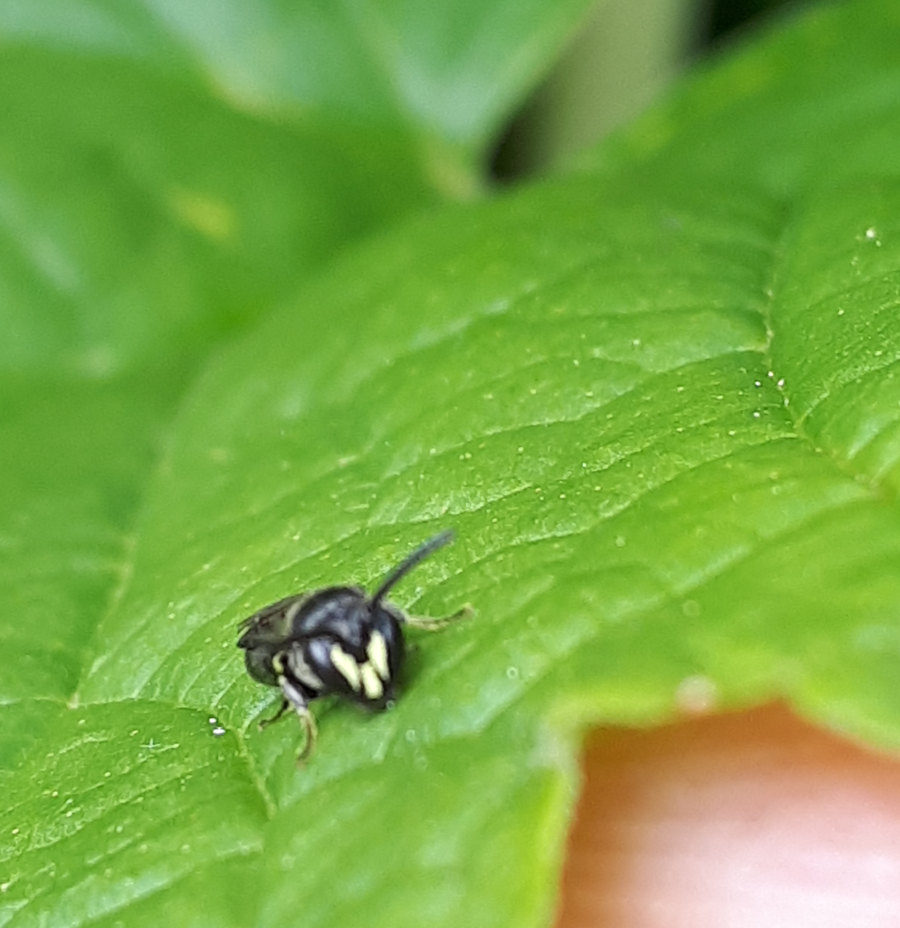
Maybe the reason I had never seen a Common Yellow-face Bee was that they are so tiny! Philip noticed several sitting around on leaves in the garden this morning so I got a couple of pics. I am going to charge my drill and go out and make a load of holes in the tree stump to help them out. Also, nearby a tiny Ruby-tailed Wasp sp was lurking, possibly a parasite of the Yellow-faces?
Common Yellow-face Bees.
The Spring that keeps on giving!
I have never had the chance to go looking for a Black-headed Bunting in Britain as they have always tended to turn up in private gardens, or on remote islands off the west or north coast of Scotland. So, when Craig Thomas found a handsome male BHB along Old Fall hedge at Flamborough on Friday afternoon, I realised I had a chance to finally see one. My old mate Philip was visiting for the weekend and although he had seen dozens in Armenia the week before, he too had never seen one in Britain, so with positive early news on Saturday morning, we headed east for Flamborough.
Old Fall hedge, east side.
We joined a small group of birders standing on the road verge scanning down the east side of Old Fall hedge and to our delight, our colourful quarry was happily sitting on a Hawthorn bush about 50 metres away. Great stuff! A chunky bunting, with bright yellow underparts and black head, and a surprisingly bright rufous nape and mantle.
Having missed this species in Cyprus a few years ago, this was a world tick for me and thoroughly appreciated. After enjoying good views and helping arriving birders to see it, the bird suddenly flicked off the bush and disappeared.
Black-headed Bunting. Smart dude.
A little later and despite some rather selfish and impatient photographers walking down the hedge (which risked flushing the bird) the bunting popped back up, this time much closer and head on, enabling us to enjoy the golden yellow underparts and jet black head. Again, the bird chilled for a minute or two, and then dropped back into the crop field, presumably to feed. He reappeared further along the hedge where for a while he interacted with a male Yellowhammer, seemingly getting the better of the local bird.
News that the Subalpine Warbler had been seen again at the golf course willows prompted our departure and we headed down there, where we bumped into a few of our friends.
Golf course twitch. Spot two Yorkshire Terriers, me and Mark P at the left hand end. Also note Craig Thomas having a sit down. It's clearly hard work all this rarity finding!
We hung out and soon saw the little grey Subalp feeding through the rose bushes, Willows and the large Sycamore. It was very actively feeding, alongside Chiffchaff and Lesser Whitethroat. Try as I might, I couldn't see the white in the tail very well, which would be essential to help with specific identification (Moltoni's vs Western vs Eastern) so thought I'd try and video it with my phone. This was successful, though sadly didn't help matters as it kept it's tail closed most of the time. Nevertheless, the bird showed well every now and again and it was enjoyable birding with good mates in warm June sunshine.
Female (presumed Western) Subalpine Warbler. Other photos by Trev Charlton revealed the tail pattern, making Western the most likely species.
Across the head, the rainclouds were piling up ominously and we noticed many Burnet Moth sp chrysalises in the grassland, along with a few Northern Marsh Orchids. We had a short seawatch, from the new hide, with the most noticeable thing being the large numbers of Painted Lady butterflies moving across the headland, presumably part of a large immigration.
Flamborough lighthouse, Northern Marsh Orchid, Burnet moth sp chrysalis
Later on, the family arrived and we headed to North Landing to check out the caves and the intertidal stuff, noting a tiny Bee Orchid in the grassland next to the slipway. Razorbills, my fave auk, gave good views, but Puffins were sparse. Thoroughly soaked - the rain had arrived - we finished the day at the YWT Living Seas Centre, where the kids did some marine-themed activities as part of World Ocean Day.
Puffin, plus Razorbills, North Landing.
A great day at the Great White Cape in the Spring that keeps on giving!
Garfish skull, courtesy of Ant Hurd, Living Seas Centre. Found on South Landing beach today.
Old Fall hedge, east side.
We joined a small group of birders standing on the road verge scanning down the east side of Old Fall hedge and to our delight, our colourful quarry was happily sitting on a Hawthorn bush about 50 metres away. Great stuff! A chunky bunting, with bright yellow underparts and black head, and a surprisingly bright rufous nape and mantle.
Having missed this species in Cyprus a few years ago, this was a world tick for me and thoroughly appreciated. After enjoying good views and helping arriving birders to see it, the bird suddenly flicked off the bush and disappeared.
Black-headed Bunting. Smart dude.
A little later and despite some rather selfish and impatient photographers walking down the hedge (which risked flushing the bird) the bunting popped back up, this time much closer and head on, enabling us to enjoy the golden yellow underparts and jet black head. Again, the bird chilled for a minute or two, and then dropped back into the crop field, presumably to feed. He reappeared further along the hedge where for a while he interacted with a male Yellowhammer, seemingly getting the better of the local bird.
News that the Subalpine Warbler had been seen again at the golf course willows prompted our departure and we headed down there, where we bumped into a few of our friends.
Golf course twitch. Spot two Yorkshire Terriers, me and Mark P at the left hand end. Also note Craig Thomas having a sit down. It's clearly hard work all this rarity finding!
We hung out and soon saw the little grey Subalp feeding through the rose bushes, Willows and the large Sycamore. It was very actively feeding, alongside Chiffchaff and Lesser Whitethroat. Try as I might, I couldn't see the white in the tail very well, which would be essential to help with specific identification (Moltoni's vs Western vs Eastern) so thought I'd try and video it with my phone. This was successful, though sadly didn't help matters as it kept it's tail closed most of the time. Nevertheless, the bird showed well every now and again and it was enjoyable birding with good mates in warm June sunshine.
Female (presumed Western) Subalpine Warbler. Other photos by Trev Charlton revealed the tail pattern, making Western the most likely species.
Across the head, the rainclouds were piling up ominously and we noticed many Burnet Moth sp chrysalises in the grassland, along with a few Northern Marsh Orchids. We had a short seawatch, from the new hide, with the most noticeable thing being the large numbers of Painted Lady butterflies moving across the headland, presumably part of a large immigration.
Flamborough lighthouse, Northern Marsh Orchid, Burnet moth sp chrysalis
Later on, the family arrived and we headed to North Landing to check out the caves and the intertidal stuff, noting a tiny Bee Orchid in the grassland next to the slipway. Razorbills, my fave auk, gave good views, but Puffins were sparse. Thoroughly soaked - the rain had arrived - we finished the day at the YWT Living Seas Centre, where the kids did some marine-themed activities as part of World Ocean Day.
Puffin, plus Razorbills, North Landing.
A great day at the Great White Cape in the Spring that keeps on giving!
Garfish skull, courtesy of Ant Hurd, Living Seas Centre. Found on South Landing beach today.
Sunday, 2 June 2019
Redneck and the Great Creak
After a week in Derbyshire with no birds and a handful of moths, I had a few hours to kill today (Saturday 1st June). After finishing my jobs, I decided to go to Wykeham to have a look for the Honey Buzzards. Sadly, I was defeated by rain and traffic on the A64, so I span round and headed west instead, to Fairburn Ings.
The diminutive Red-necked Phalarope, a relatively drab male, was watched from the roadside platform swimming about around the islands in the main bay. A typical late spring migrant it was incredible to think this bird could have spent the winter off the Peruvian coast, before heading back across the Central American isthmus, over the Atlantic to Fairburn Ings, West Yorkshire! I watched the bird which stayed close in to one of the islands, occasionally spinning around to stir up critters. The Avocets nesting on the islands had a few chicks and two migrant Dunlins were also present.
Redneck. Always against the light so not great for phonescoping.
Next up, I decided to head down to Wintersett to have a look for the Great Reed Warbler.
The giant Acro was audible on arrival clanking and creaking away in its favoured reedbed. After a bit, I managed to pick the bird up, sitting close to the water's edge on swaying reed stems, singing away. His song seemed a little half-hearted; perhaps he realised there were no female Great Reed Warblers at Wintersett.
Great Reed Warbler. My first in Britain since one at Paxton Pits in 2016 (see here) and my first in Yorkshire since 5th May 1990 which I watched in a ditch at Sammy's Point, Spurn.
...
Two Hobbies were catching damselflies, of which there had been an immense emergence and I heard and saw a Cetti's Warbler.
...
I finished the day on a Yorkshire heath listening to Nightjars churr. Gorgeous!
The diminutive Red-necked Phalarope, a relatively drab male, was watched from the roadside platform swimming about around the islands in the main bay. A typical late spring migrant it was incredible to think this bird could have spent the winter off the Peruvian coast, before heading back across the Central American isthmus, over the Atlantic to Fairburn Ings, West Yorkshire! I watched the bird which stayed close in to one of the islands, occasionally spinning around to stir up critters. The Avocets nesting on the islands had a few chicks and two migrant Dunlins were also present.
Next up, I decided to head down to Wintersett to have a look for the Great Reed Warbler.
The giant Acro was audible on arrival clanking and creaking away in its favoured reedbed. After a bit, I managed to pick the bird up, sitting close to the water's edge on swaying reed stems, singing away. His song seemed a little half-hearted; perhaps he realised there were no female Great Reed Warblers at Wintersett.
Great Reed Warbler. My first in Britain since one at Paxton Pits in 2016 (see here) and my first in Yorkshire since 5th May 1990 which I watched in a ditch at Sammy's Point, Spurn.
...
Two Hobbies were catching damselflies, of which there had been an immense emergence and I heard and saw a Cetti's Warbler.
...
I finished the day on a Yorkshire heath listening to Nightjars churr. Gorgeous!
Sunday, 26 May 2019
Baikal/Bakewell/Toytown Teal
A stunning drake Baikal Teal had arrived in Yorkshire on Friday, after spending a few weeks on the Ouse Washes in Cambridgeshire. The bird showed well at Kilnsea Wetlands before heading north again to Hornsea Mere. I convinced Duncan Bye to leave Wheldrake for a few hours this morning and we headed east to have a look for the bird.
After failing to see it from the south side of the Mere, we headed round to Wassand Hide and saw the bird with three Wigeon on Decoy Bay. A stunningly handsome duck, if accepted as wild, it will be only the eight record for Britain and the second for Yorkshire, so a level of rarity only surpassed by its beauty.
I dipped the previous Yorkshire bird, at Flamborough Head in spring 2013, so this was especially pleasing to see and in much better plumage than the bird I had seen at Minsmere back in 2001. We also saw Hobby, Marsh Harrier, Teal, Goldeneye and plenty of Swifts. Several Cetti's Warblers sang too.
Baikal Teal. Difficult to phonescope in poor light and a fresh westerly wind.
Back at Bank Island, a drake Garganey dabbled about, along with a Little Ringed Plover, Little Egret and three Oystercatchers.
After failing to see it from the south side of the Mere, we headed round to Wassand Hide and saw the bird with three Wigeon on Decoy Bay. A stunningly handsome duck, if accepted as wild, it will be only the eight record for Britain and the second for Yorkshire, so a level of rarity only surpassed by its beauty.
I dipped the previous Yorkshire bird, at Flamborough Head in spring 2013, so this was especially pleasing to see and in much better plumage than the bird I had seen at Minsmere back in 2001. We also saw Hobby, Marsh Harrier, Teal, Goldeneye and plenty of Swifts. Several Cetti's Warblers sang too.
Baikal Teal. Difficult to phonescope in poor light and a fresh westerly wind.
Back at Bank Island, a drake Garganey dabbled about, along with a Little Ringed Plover, Little Egret and three Oystercatchers.
Saturday, 25 May 2019
Goshawk Nest-cam
This New Forest Goshawk nest-cam is fantastic and well worth a watch!
There are four happy chicks in the nest and if you watch for a bit you have a good chance of seeing one of the adult Goshawks coming in with food or just to check up on the chicks.
Yorkshire Record Breakers: an epic May day!
It's 1.30 am and pitch black. I'm stood shin-deep in rain-soaked grass
in the Lower Derwent Valley, near York, straining my ears for the nasal
rattle of a drake Garganey.
I know this handsome duck is here somewhere – I saw him several hours
earlier – but he's done a bunk and I feel gutted, though I don't let on
to my team mates. Suddenly, an unexpected call pierces the darkness: "Common Sandpiper!"
exclaims Mark instantly. Game on: a good bird and one we knew we
couldn't expect to see later (as it turned out, we didn't!). Our
collective spirit lifted, our soggy trousers and wet feet were soon
forgotten as we piled back into the car and headed off on our Yorkshire
Big Day.
Garganey, North Duffield Carrs last year
To read the full write-up from Team Dirty Habicht's Yorkshire Big Day - check it out on the Birdguides website.
To view our full record-breaking list, see here.
Friday, 24 May 2019
Going plastic free, bit by bit!
We have all seen how the production of plastic waste, particularly from single-use sources is not only causing huge ecological damage in our oceans but is also using lots of fossil fuels to produce in the first place. We should all try and reduce our useage, particularly of single-use plastic and definitely where there is a simple alternative.
Going entirely plastic free is very hard living in Britain, but it is not all or nothing. If everybody just reduced their use/purchase of single-use plastic just a bit, collectively it would have a HUGE impact! This year, our family resolution was to take some simple steps to reduce our single-use plastic and to be honest it has been pretty easy! Here is what we have done so far:
(*we were doing some of this stuff already to be honest, at least some of the time, we now just do it all the time!)
None of these things are particularly difficult. Milk and veg delivery is a bit more expensive than buying the same wrapped in plastic from supermarkets, but what cost the Earth?
Please do what you can. As somebody once said, every little helps!
Going entirely plastic free is very hard living in Britain, but it is not all or nothing. If everybody just reduced their use/purchase of single-use plastic just a bit, collectively it would have a HUGE impact! This year, our family resolution was to take some simple steps to reduce our single-use plastic and to be honest it has been pretty easy! Here is what we have done so far:
- Always carry a water bottle so we don't have to purchase water while out and about.*
- Always carry a drinks container just in case we fancy a coffee on the go.*
- Get our milk delivered in glass bottles to our door. This has been great as we very rarely run out of milk these days!
- Buying dry goods (eg rice) from Bishy Weigh in York to avoid plastic packaging.
- Getting a weekly organic veg box delivered to our door.
- Taking containers to the supermarket deli so that they don't put your cheese in a bag.
- Stopped using plastic bags to put your fruit in at the supermarket.*
- Recycling ALL recyclable plastic products at St Nick's in York via Bishy Weigh.
- Never use single-use carrier bags - we take our own bags with us when shopping.*
- Never use plastic drinking straws when out. If there is no paper straw alternative, we drink from the glass. Like adults.
(*we were doing some of this stuff already to be honest, at least some of the time, we now just do it all the time!)
None of these things are particularly difficult. Milk and veg delivery is a bit more expensive than buying the same wrapped in plastic from supermarkets, but what cost the Earth?
Please do what you can. As somebody once said, every little helps!
Monday, 20 May 2019
Easington Collared Flycatcher
Two big Yorkshire rarities turned up during our Yorkshire Big Day attempt on 11th May. The first we were fortunate enough to connect with, a delightful female Collared Flycatcher at Easington Cemetery, whilst the second, a singing male Brown Shrike at Cowden, was tantalizingly close, but sadly just out of reach.
Collared Flycatcher is a first-class rarity and a spring male certainly takes some beating for handsomeness (and I do have a thing for black and white species...). The story of my first British Collared Flycatcher can be read here. This female was very enjoyable too, not least because it was a huge bonus bird for our Yorkshire Big Day but also because it is a potentially tricky identification, so getting some, albeit brief, experience with this species is always good. We were fortunate to arrive on site not too long after it had been identified and the little lady performed beautifully, flicking about in roadside trees and at one point descending to a puddle on the edge of the road.
Note the greyish collar and broad white primary patch almost reaching the wing-edge
I was sad not to have a longer look, but the Big Day called us away...
Collared Flycatcher is a first-class rarity and a spring male certainly takes some beating for handsomeness (and I do have a thing for black and white species...). The story of my first British Collared Flycatcher can be read here. This female was very enjoyable too, not least because it was a huge bonus bird for our Yorkshire Big Day but also because it is a potentially tricky identification, so getting some, albeit brief, experience with this species is always good. We were fortunate to arrive on site not too long after it had been identified and the little lady performed beautifully, flicking about in roadside trees and at one point descending to a puddle on the edge of the road.
Note the greyish collar and broad white primary patch almost reaching the wing-edge
I was sad not to have a longer look, but the Big Day called us away...
Black Gold
Friday 10th May: The last gasp of reconnaissance for our Yorkshire Big Day the following day - more to come on that later! With easterly winds and a little rain during the week, I initially headed out locally, to Bank Island and then onto Wheldrake Ings.
At Bank Island I was pleased to note the Pintail pair and a drake Garganey - these would both come in handy tomorrow as both are scarce Yorkshire birds. On to Wheldrake Ings, noting several Garden Warblers singing along the way down to Tower Hide, their chattering melodic ramble reminiscent of and yet different to the fluting notes of nearby Blackcaps. To the right of the Tower Hide, 25 humbug-headed Whimbrel were probing the meadows. This felt a little unusual; they usually frequent fields near Storwood, only flying to Wheldrake to roost. Perhaps the recent dry weather has meant foraging is more rewarding here in the damp herb-rich meadows.
Round to Swantail and I picked up the dusky form of an adult Spotted Redshank, tailing a Common Redshank, an elegant slender shadow. Spotshanks are a pretty scarce bird in the York area, with only a small handful of records every year, so this dusky bird was true patch gold.
Always distant, the Redshank's shadow.
After drawing a relative blank at North Duffield Carrs, I headed west to the Aire Valley to pin down some key species for the next day. Greenshanks flew over, Green Woodpeckers yaffled, Spoonbills bounced around in the trees and Bearded Tits flew in to greet me - I doubt it would be this easy in 24 hours' time!
Little Owl, St Aidan's RSPB. Little did I know how important this owl would be the following day...
At Bank Island I was pleased to note the Pintail pair and a drake Garganey - these would both come in handy tomorrow as both are scarce Yorkshire birds. On to Wheldrake Ings, noting several Garden Warblers singing along the way down to Tower Hide, their chattering melodic ramble reminiscent of and yet different to the fluting notes of nearby Blackcaps. To the right of the Tower Hide, 25 humbug-headed Whimbrel were probing the meadows. This felt a little unusual; they usually frequent fields near Storwood, only flying to Wheldrake to roost. Perhaps the recent dry weather has meant foraging is more rewarding here in the damp herb-rich meadows.
Round to Swantail and I picked up the dusky form of an adult Spotted Redshank, tailing a Common Redshank, an elegant slender shadow. Spotshanks are a pretty scarce bird in the York area, with only a small handful of records every year, so this dusky bird was true patch gold.
Always distant, the Redshank's shadow.
After drawing a relative blank at North Duffield Carrs, I headed west to the Aire Valley to pin down some key species for the next day. Greenshanks flew over, Green Woodpeckers yaffled, Spoonbills bounced around in the trees and Bearded Tits flew in to greet me - I doubt it would be this easy in 24 hours' time!
Little Owl, St Aidan's RSPB. Little did I know how important this owl would be the following day...
Subscribe to:
Posts (Atom)